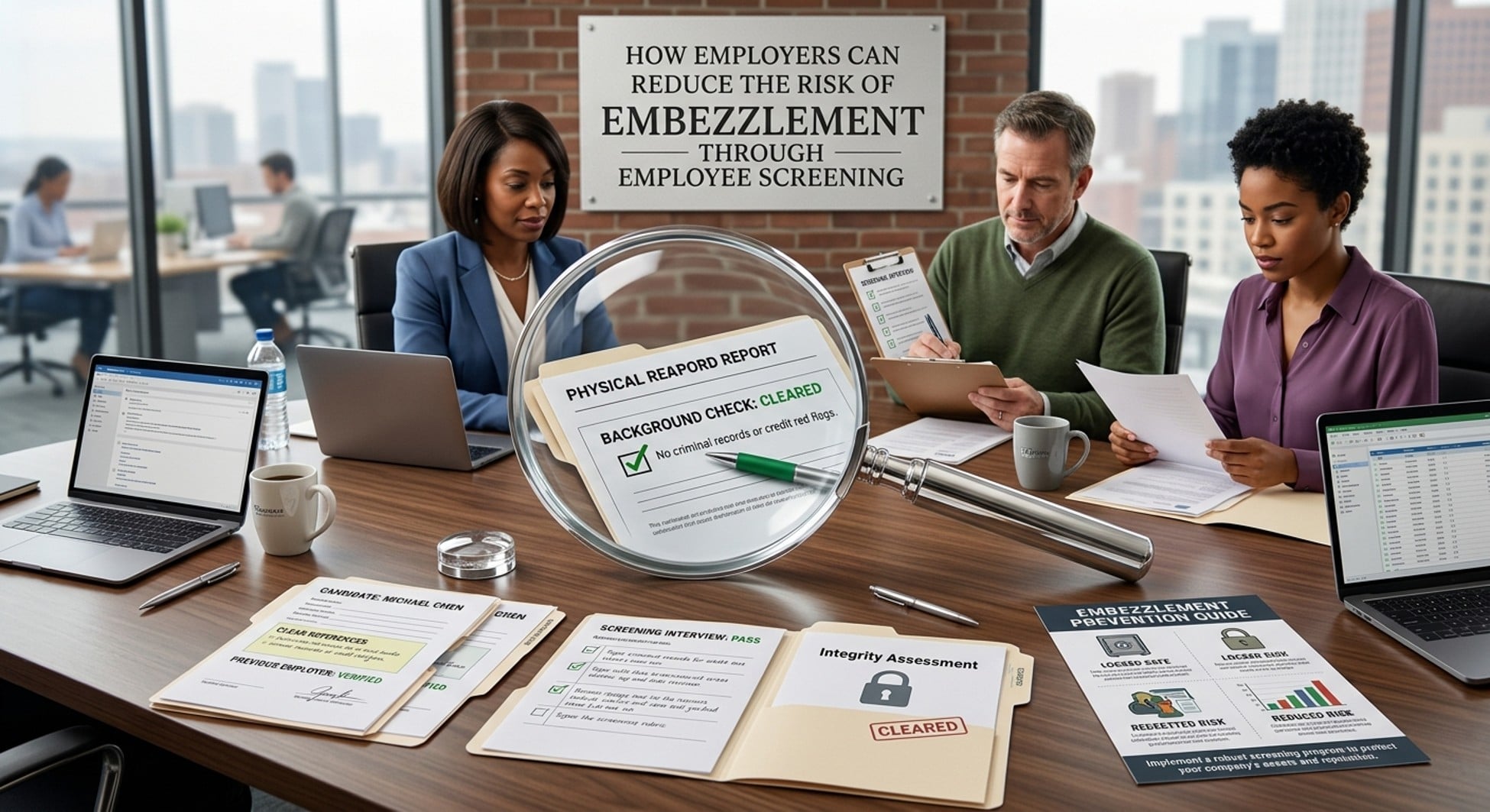
Embezzlement can cause significant financial and reputational damage to a business. It often involves employees misusing money, assets, or financial information entrusted to them. While no screening process can eliminate fraud completely, effective Employee Screening can help organizations identify potential risks before they become costly problems.
Employers can combine pre-employment checks, appropriate verification procedures, and ongoing internal controls to create a stronger approach to fraud prevention.
- Understanding Embezzlement and Its Risks
- Why Employee Background Checks Matter
- Applying the Fraud Triangle Theory
- When Financial Screening Becomes More Important
- The Role of AML Background Check Processes
- Lessons From Major Corporate Fraud Cases
- How Technology Can Support Screening
- Building a Stronger Fraud Prevention Strategy
Related Articles
-
 The Impact of Criminal Convictions on Employment Opportunities
-
 5 Things to Know About a Pre-Employment Background Check
-
 Complying with the Fair Credit Reporting Act
-
8 Important Reasons You Don’t Drink and Drive
-
What’s Considered Public Record?
-
Legal Checklist for New Hires
-
Background checks for overseas employees – what businesses…
-
The Importance of Background Checks When Hiring Non-Nationals


Understanding Embezzlement and Its Risks
The Embezzlement generally refers to the misappropriation or theft of money or property by someone who has been entrusted with it. Unlike a conventional theft by an outsider, embezzlement can occur when an employee uses legitimate access to company resources for personal gain.
Common Embezzlement examples include an employee transferring company funds into a personal account, manipulating expense reports, creating unauthorized payments, or misusing company assets. These activities can remain unnoticed when businesses lack adequate controls and employee oversight.
Understanding these risks allows employers to consider screening as one part of a broader fraud prevention strategy.
Why Employee Background Checks Matter
Employee background check can provide useful information during the hiring process, particularly for positions involving money, sensitive customer information, financial systems, or significant decision-making authority.
Depending on applicable laws and the position, employers may review employment history, professional qualifications, identity information, and other relevant records. The purpose is not to assume that a particular background automatically indicates future misconduct. Instead, screening helps employers make informed hiring decisions while following applicable employment and privacy requirements.
Employers should also ensure that screening practices are consistent, job-related, and compliant with relevant laws.
Applying the Fraud Triangle Theory
The fraud triangle theory is commonly used to explain three conditions that can contribute to fraudulent behavior: pressure, opportunity, and rationalization.
Employee screening primarily addresses the risk associated with information available before hiring, but it cannot identify every future pressure or motivation an employee may experience. For this reason, businesses should combine screening with controls that reduce opportunities for unauthorized financial activity.
A practical fraud prevention framework can include:
- Pre-employment verification appropriate to the role
- Segregation of financial responsibilities
- Regular review of transactions and expense activity
- Restricted access to sensitive financial systems
- Clear reporting channels for suspected misconduct
These measures can make it more difficult for fraudulent activity to occur and easier to identify unusual behavior.
When Financial Screening Becomes More Important
Not every employee requires the same level of screening. A company may reasonably apply additional checks to positions that involve direct access to financial assets, payment systems, customer accounts, or confidential information.
For example, employees working in accounting, finance, payroll, banking operations, or payment processing may present different operational risks from employees without access to financial systems.
A risk-based approach allows organizations to apply appropriate controls without treating every employee as having the same level of potential exposure.
The Role of AML Background Check Processes
An aml background check can form part of a broader compliance process when an employee’s responsibilities involve financial crime prevention, customer due diligence, or regulated financial activity.
AML-related screening is different from a conventional employment check. It may involve reviewing relevant sanctions, politically exposed persons, adverse media, or other risk indicators depending on the organization’s obligations and the role being assessed.
Businesses operating in financial services should distinguish employment screening from customer due diligence. A customer background check, for example, is generally focused on understanding customer identity and risk rather than evaluating a prospective employee.
Lessons From Major Corporate Fraud Cases
Large corporate scandals demonstrate why strong controls matter. The Wirecard fraud case, for instance, highlighted the consequences that can arise when financial information, oversight, and controls fail to provide an accurate picture of business activity.
While employee screening alone could not prevent a complex corporate fraud, it illustrates why organizations need multiple layers of verification, oversight, governance, and risk management.
Screening should therefore be viewed as an early risk-management measure rather than a complete fraud prevention solution.
How Technology Can Support Screening
Modern compliance technology can help organizations manage screening processes more consistently. Solutions can automate checks, monitor relevant risk information, maintain records, and support compliance teams as organizations grow.
For companies managing AML-related responsibilities, AML Watcher provides screening capabilities designed to support financial crime risk management. Technology can complement human judgment by helping teams organize and review relevant information more efficiently.
However, technology should operate alongside appropriate policies, internal controls, employee training, and legal oversight.
Building a Stronger Fraud Prevention Strategy
Reducing embezzlement risk requires more than checking an applicant’s history. Employers should establish screening procedures that match the responsibilities of each position and combine them with strong financial controls.
Regular access reviews, separation of duties, transaction monitoring, employee awareness, and clear reporting procedures can further reduce opportunities for misconduct. Ultimately, effective Employee Screening is one layer of a wider risk management framework. When combined with appropriate controls and ongoing oversight, it can help employers make better-informed hiring decisions and strengthen their ability to prevent and detect workplace financial fraud.