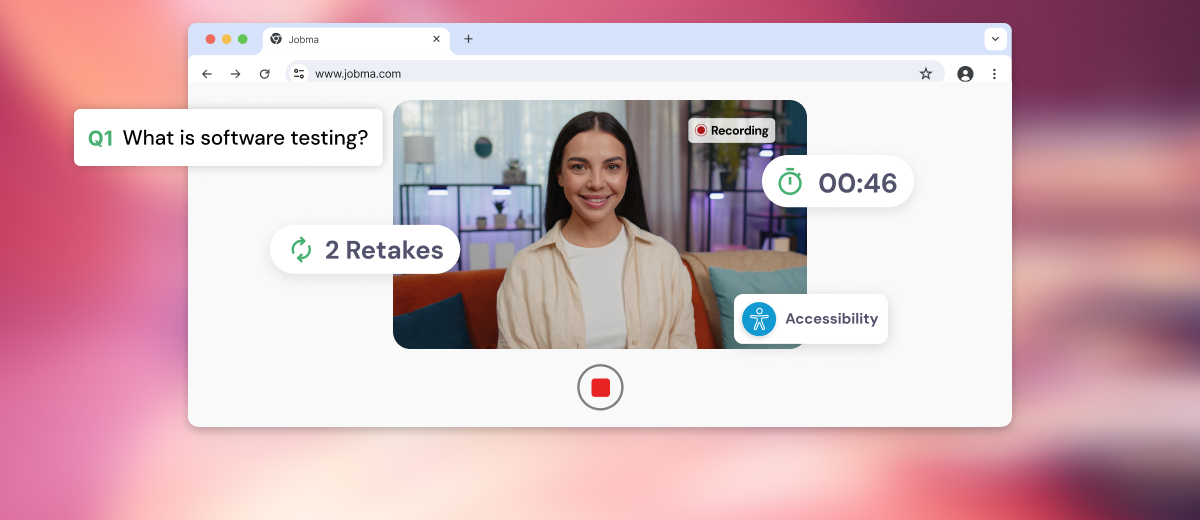
Hiring teams today face rising application volumes, tighter hiring timelines, and growing pressure to validate skills. As a result, early‑stage screening has become a critical bottleneck in the hiring process.
Focused on improving efficiency, consistency, and candidate‑evaluation quality, video interviewing has become part of a broader hiring‑intelligence strategy.
To truly understand candidate potential, organizations need structured evaluation, skills validation, and AI‑assisted context that can scale across thousands of applicants.
Jobma provides an AI‑powered platform for on‑demand (one‑way) video interviews, designed to remove scheduling friction while maintaining evaluation rigor and candidate accessibility.
In this article, we’ll unpack the mechanism of Jobma’s on‑demand/one‑way interviews, their technical capabilities, and how recruiting teams configure them to meet specific hiring objectives.
- What is Jobma?
- What is a One-Way (On-Demand) Video Interview?
- How Does Jobma’s One-Way (On-Demand) Video Interview Work?
- Platform Capabilities & Core Features
- Key Differentiators of Jobma vs Its Competitors
- Why Do Companies Use Jobma?
- Who Uses Jobma?
- Challenges of On-Demand/One-Way Video Interviewing
Related Articles
-
 The Impact of Criminal Convictions on Employment Opportunities
-
What Is a Staff Accountant vs. Accountant?
-
Legal Rights and Obligations of Employers and Employees in Attend…
-
Perfecting Your Job Proposal: A Guide for Writing an Outstanding…
-
Data-driven Recruiting 101: How to Improve Your Hiring Process
-
Why Do Employers Employ Females Than Males?
-
Hiring a Professional Resume Writer: 4 Factors to Consider


What is Jobma?
Jobma is an AI video interviewing and assessment platform designed to evaluate candidates through structured assessments and video interviews. It strengthens hiring decisions through deep talent intelligence, layered validation, real-time proctoring signals, and audit-ready reporting.
It is built around a human-centered approach to hiring technology. Instead of automating decisions, the platform focuses on elevating the hiring experience by enabling teams to better understand candidates’ potential through skill validation, AI-driven insights, structured evaluation, and a collaborative hiring workflow.
By providing layered validation and real-time proctoring signals, every hiring decision is backed by audit-ready reporting and ethical AI insights. It serves as a functional bridge between the recruiter and the candidate during the hiring process.
What is a One-Way (On-Demand) Video Interview?
An on‑demand (one‑way or asynchronous) video interview is a pre‑recorded evaluation stage where candidates respond to prompts or questions on their own schedule, submitting video answers that hiring teams review later. Instead of scheduling screening calls or interviews one‑by‑one, recruiters can send interview invitations that candidates complete asynchronously, often through desktop or mobile devices.
This shift from live to pre‑recorded screening creates three strategic advantages:
- Standardization: All candidates for the same role receive the same questions, timing rules, and retake options.
- Scalability: Recruiters can screen hundreds or thousands of applicants without manual scheduling.
- Brand‑building: The interview invite, landing page, intro video, and prompts become repeatable brand touchpoints in the candidate journey.
Because the experience is asynchronous, it removes scheduling friction while preserving structure and fairness, making it ideal for early‑stage screening, especially in high‑volume, multi‑location, or skills‑first hiring contexts.
How Does Jobma’s One-Way (On-Demand) Video Interview Work?
Jobma’s on‑demand workflow is designed to simplify screening while preserving rigour and candidate experience. At a working level, here’s how it plays out for recruiters and hiring teams.
Interview Setup: Jobma’s workflow starts when a hiring team builds an interview kit based on the role requirements, including:
- Question types (video, audio, written, multi‑choice, coding)
- Timing rules (think time before response, response time limit, retake rules)
- Scoring rubrics (Behavioural indicators, Technical skills criteria, & Communication and language thresholds)
This step is where TA leaders can incorporate skills‑based hiring logic, designing questions that mirror real‑world tasks, scenarios, or problem‑solving requirements rather than relying purely on past experience.
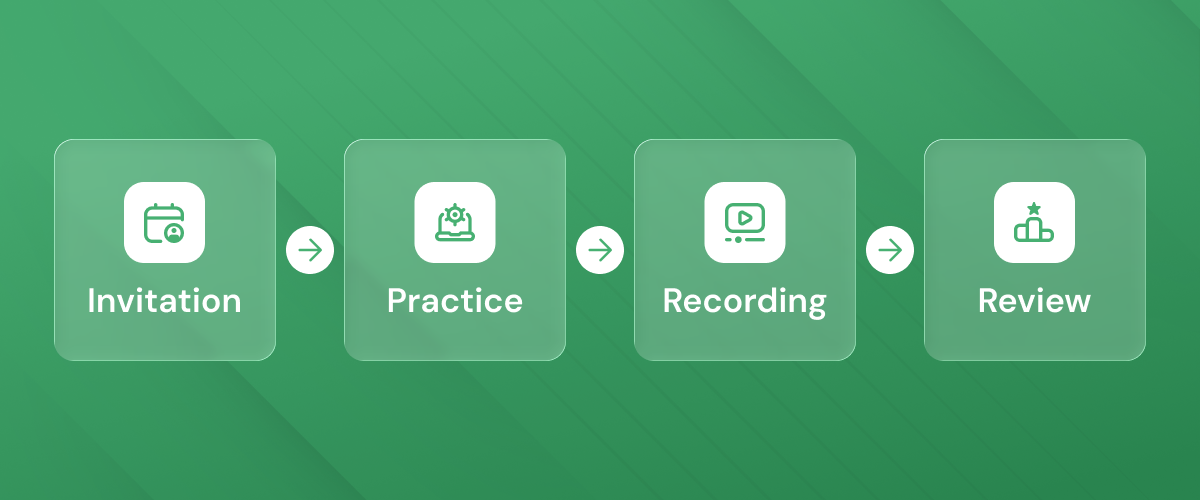
Invitation & Candidate Experience: Candidates receive a branded interview link (usually via email or SMS) and complete the interview through a web browser or the Jobma mobile app. The flow looks like this:
- Click the interview invite link.
- Verify identity (optional ID‑check step).
- Enter a practice mode to test the setup and become comfortable.
- Receive questions one by one and record responses within configured time limits.
Key design choices that shape experience and outcomes:
- Practice Mode: Reduces anxiety and improves completion rates.
- Multi-device Compatibility: Ensures candidates can participate from any device.
- Clear Instructions and Timing Cues: Help standardize responses.
- Limited Retakes and Time Bounds: Keep evaluation consistent and fair.
Review & AI-Assisted Insights: Hiring teams assess the video responses alongside AI-assisted insights: summary, transcripts, and scores. Reviewers can leave comments, assign scores, share the interview link with other team members, and compare evaluations across multiple reviewers. This keeps the hiring team aligned, even across departments and regions.
Maintain Interview Integrity: Jobma embeds non‑invasive AI proctoring to help safeguard integrity without intruding on candidate privacy. The platform can flag window switching, multiple faces, copy-paste detection, and potential AI-generated content detection.
These signals are logged and surfaced to hiring teams, giving them visibility into potential integrity issues while preserving candidate privacy and transparency. The logs also support audit‑ready reporting for compliance reviews.
Platform Capabilities & Core Features
On‑demand video interviewing in Jobma operates as part of a broader hiring workflow system, not as an isolated tool. It sits between application and live interview, standardising early‑stage evaluation while feeding structured data into ATS and downstream stages.
Asynchronous Video Interviews: One of the most persistent challenges in early-stage hiring is coordination overhead. Async video interviews allow recruiters to conduct structured one-way video interviews that candidates can complete on their own schedule. This allows hiring teams to screen more candidates efficiently without depending on live scheduling coordination.
ID Verification: Ensuring candidate authenticity has become a critical requirement, particularly in high-stakes or regulated hiring environments. Jobma’s ID verification capability helps organizations confirm candidate identity before or during the interview process, adding an additional layer of trust and integrity to remote hiring workflows.
Candidates can be prompted to verify their identity through structured validation steps before proceeding with their interview. This ensures that the individual completing the assessment is the same person being evaluated throughout the hiring process.
Live Video & Panel Interviews: For later-stage hiring conversations, Jobma supports live virtual interviews and panel interviews with multiple reviewers. Teams can manage the entire candidate journey – from one-way screening to live interviews, within the same platform. This continuity helps maintain a consistent candidate experience and keeps evaluation data in one place for later‑stage decision‑making.
Multi-Format Interview Questions: Different roles require fundamentally different signals of candidate readiness. Jobma enables hiring teams to design interview experiences that reflect the actual nature of the role. By combining video responses, written answers, audio inputs, multiple-choice questions, and coding challenges within a single workflow, recruiters can build evaluation journeys that mirror real job expectations more closely. This leads to a more accurate understanding of candidate capability.
Automated Interview Scheduling: Interview scheduling, reminders, and follow-ups often require manual effort that pulls recruiters away from higher-value evaluation work. Jobma’s automated scheduling capabilities help reduce this operational load by streamlining how interviews are assigned and completed. Jobma streamlines coordination with – automated scheduling, slot selection for recruiters and candidates, and calendar integrations. This reduces manual back‑and‑forth and improves candidate experience.
Coding Assessments: Technical teams can evaluate programming skills, problem‑solving ability, and real‑world coding tasks directly within Jobma’s platform. These assessments can be embedded into one‑way interviews or triggered during live virtual sessions, giving hiring managers a clearer, data‑driven view of coding proficiency. By combining coding challenges with video interviews, recruiters can see both what a candidate writes and how they think.
Advanced Analytics & Reporting: The platform provides hiring teams with reporting and analytics tools that support candidate tracking, interview completion analysis, hiring workflow visibility, recruiter collaboration, and structured evaluation reporting. This data can be used to optimize question length and structure further, identify bottlenecks in the hiring funnel, and refine evaluation criteria.
Seamless ATS & HR Integrations: Jobma integrates with Applicant tracking systems (ATS), HR platforms via API and Zapier, CRM, and other tech stacks seamlessly. This allows organisations to embed on‑demand interviews directly into existing workflows, reducing friction and enhancing data flow.
Gamified Assessments: Engage candidates using interactive, scenario-driven questions that reveal practical skills, mindset, and real-world readiness. This allows hiring teams to observe how the candidate responds under applied conditions.
Language Proficiency Assessments: For roles where language and communication matter, Jobma enables language proficiency assessments that align with role‑specific requirements. Recruiters can evaluate communication and language proficiency through built-in validation tools aligned with role-specific requirements. This helps ensure candidates meet communication thresholds for customer‑facing, global, or language‑dependent roles, while keeping the experience fair and consistent.
Key Differentiators of Jobma vs Its Competitors
Jobma is positioned to sit at the intersection of scalability, flexibility, candidate experience, and structured hiring intelligence, differentiating it from both “basic recording” platforms and highly complex enterprise systems.
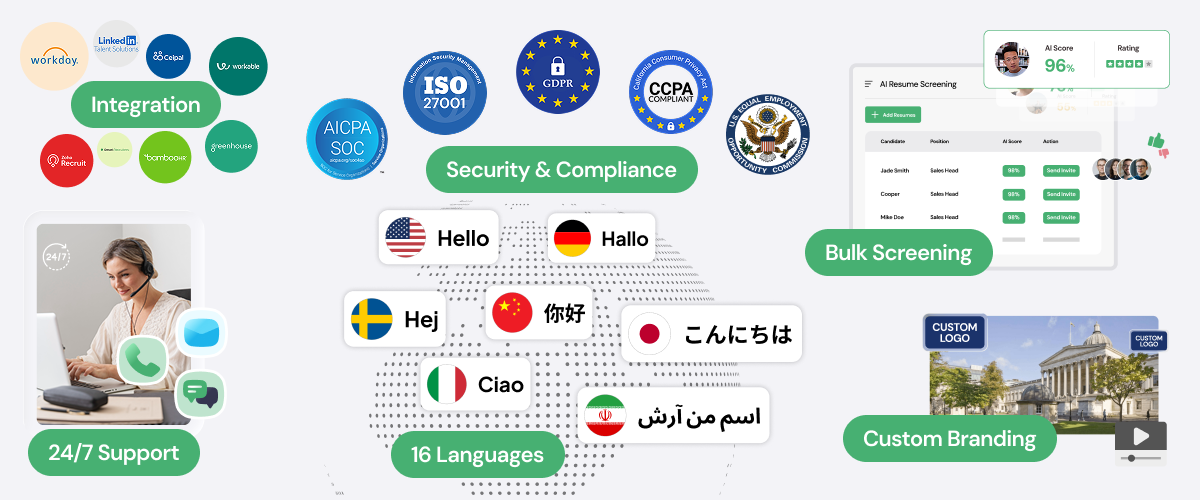
Key differentiators:
16 Languages: Multilingual capabilities to help organizations create a more accessible hiring experience for the global candidate pipeline without friction.
24/7 Live Help Desk: Human support to help recruiters and candidates across time zones.
Collaborative Workflows: Reviewer assignments, shared notes, and aggregated scorecards. Recruiters, hiring managers, and interview panels can collaborate within centralized evaluation workflows designed to improve hiring alignment.
Part of Your Ecosystem: ATS integrations and flexible APIs to embed Jobma into existing hiring stacks.
Fully Customizable: Branded landing pages, intro videos, and configurable interview kits. Organizations can customize branding, workflows, interview structures, and evaluation processes to align with internal hiring strategies.
Secure & Compliant: SOC 2 / ISO security posture and GDPR/CCPA compliance for audit‑ready hiring.
Bulk Screening: Designed for high‑volume hiring with batch invites and automated triage.
Compared to other platforms, Jobma offers a stronger candidate experience and deeper skill validation.
Why Do Companies Use Jobma?
Organizations adopt Jobma primarily to address structural inefficiencies in early-stage hiring. Common drivers include: reduction in time‑to‑screen, improved candidate experience through clear branded communications, and scaling objective assessment across high‑volume roles, without adding recruiting headcount.
Jobma’s on‑demand one‑way interviews help teams move beyond CV‑based assumptions, hone‑screen subjectivity, and scheduling‑driven bottlenecks. Instead, hiring teams focus on validated skills, behaviour, and communication – data that predicts real‑world performance.
The platform’s AI summaries and integrated assessments are time‑savers that increase reviewer throughput and help identify top talent earlier in the funnel.
Who Uses Jobma?
Jobma serves a diverse range of clients across industries, including healthcare, higher education, staffing and recruitment, aviation, IT, and more, to manage high-volume hiring. Notable organizations using Jobma include:
- MIT
- AMN Healthcare
- Lionsgate
- Mayo Clinic
- Wargaming
- University of Washington
- Vanderbilt University Medical Center
- UNAIDS
- Dynata
- UCL School of Management
Challenges of On-Demand/One-Way Video Interviewing
While on-demand video interviewing offers significant advantages, successful implementation requires thoughtful execution.
- Candidate anxiety and technical issues can affect completion rates if practice and support aren’t provided.
- Overly long question sets or a lack of clear instructions can increase drop‑off and bias.
- Misuse of AI scoring without human oversight risks unfair outcomes; teams must combine AI signals with structured rubrics and human review.
To implement a video interviewing platform effectively, focus on:
- Clear candidate communication
- Mobile accessibility
- Structured evaluation criteria
- Balanced interview lengths
- Human oversight throughout the process
Key Takeaway: The Role of On-Demand Video Interviewing in Modern Hiring
On-demand video interviewing represents a shift in how organizations structure early-stage hiring. It introduces standardization, scalability, and consistency into a stage of hiring that has traditionally been fragmented and heavily dependent on manual coordination.
Jobma supports this shift by enabling structured video interviews, skills validation, and collaborative evaluation within a unified hiring workflow, helping organizations improve both the speed and quality of hiring decisions.