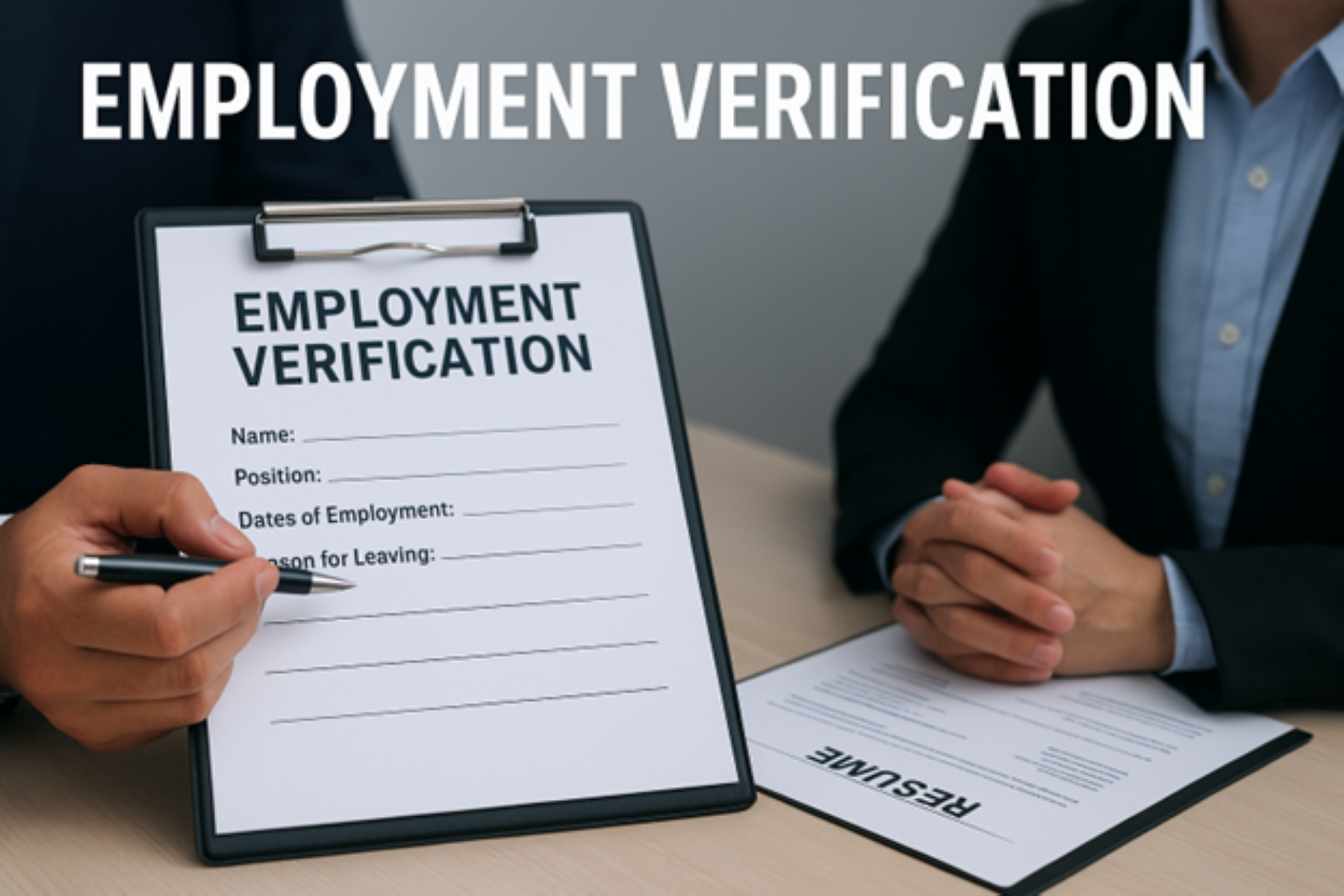
In the modern competitive employment world, conducting a background check by establishing the employment history of the candidate is no longer an option but a necessity in the hiring process. Employment verification assists the employer to establish the validity of the employment experience, job titles and income representations of the job applicant before making a hiring decision. As incidences of fraud in the resumes and fake claims continue to rise, the practice of employment verification allows organizations to be upright, legal, and reliable in the recruitment process.
Related Articles
-
 The Impact of Criminal Convictions on Employment Opportunities
-
What Is a Staff Accountant vs. Accountant?
-
Legal Rights and Obligations of Employers and Employees in Attend…
-
Perfecting Your Job Proposal: A Guide for Writing an Outstanding…
-
Data-driven Recruiting 101: How to Improve Your Hiring Process
-
Why Do Employers Employ Females Than Males?


What is Employment Verification?
Employment verification refers to the act of verifying the employment history or present employment of an applicant. It is usually done by considering the information like the name of the company, dates of employment, job position, salary, and termination reason. This check may be conducted by the employer himself or his agency or as part of a larger background check procedure.
Employment verification helps employers to be sure that the candidates mentioned their qualifications and experience. It can also be used to confirm financial data like income evidence which is vital in jobs that entail trust and responsibility.
The relevance of Employment Verification
Employment check is also a protection to the companies and it is minimizing the chances of recruiting incompetent or corrupt individuals. Failure to do this by employers would expose their organization to internal fraud and compliance problems or worse still, lawsuits.
In the case of the industry that handles sensitive data, like finance, insurance, or healthcare, the practice of employment verification is not only a good practice, but mandatory. It assists in safeguarding the company against internal attacks and adherence to legal requirements and moral hiring practices. Furthermore, to eliminate money laundering and frauds, it is important to authenticate evidence of income in jobs that deal with credit, loans, or other monetary dealings.
The Employment Check Process
Employment verification is normally initiated after a candidate has accepted a provisional job offer. The verification agency or employer contacts the past employers to verify the information given on the resumé of the candidate. This can be in written form, online form or over the phone, depending on the company policies and laws of data protection.
The verifier verifies crucial information including job title, tenure and salary history. Performance details or feedback regarding the behavior of the employee are also some of the verifications that are sometimes included but often restricted by the laws of privacy. This can take between a few days and several weeks, based on the quickness of the response of past employers.
Currently, automated employment verification systems that have integrated HR databases are used by a large number of companies in the digital environment. These tools are fast and minimize mistakes but retain the data security. With such systems, information such as evidence of income and employment history is verified effectively and correctly.
Law and Regulatory Implications
Verification of employment should never be done against privacy and data protection laws. Before checking the employment history of the candidates, the employers should seek their written consent. The fair credit reporting act (FCRA) regulates the background checks and verifications in areas such as the United States.
The employers should make sure that these standards are followed by third-party verification companies and personal information is processed safely. Noncompliance would lead to legal actions and negative publicity. Thus, candidates must be told the purpose of verification and scope with a lot of transparency.
Compliance is even more complicated for global companies. Cross-border verification involves a knowledge of the international labour laws, GDPR laws in Europe and all other country specific data protection laws. This is why it is important that businesses collaborate with reliable verification partners who possess experience on an international level.
Income Verification- Employment
Employment checking is not solely used in the hiring process, but also very common in financial undertakings. Landlords, employers, and government agencies usually demand employment checks as a way of validating the income of a person. This makes the applicant have a sound financial history and be able to fulfill financial responsibilities like payment of rent, loans or credit cards.
The employers can get formal requests to provide verification letters indicating the job location, employment period, and remuneration information of the employee. These records are used to make decisions by third parties who consider the financial reliability. Digital verification services have made this procedure easy and real time verification of incomes can be made secure without misuse of sensitive data.
Frequent Problems in Employment Checks
Employment verification, although it is important, may have a number of challenges. Unresponsive previous employers are one of the primary problems as they may slow the process. Also, small enterprises/startups might not keep formal HR records and thus they are hard to verify.
The other difficulty is in checking international work experience. The documentation requirements in one country may not be the same in another country and language obstacles or information protection regulations can impede the verification process. In order to conquer this, global verification providers have secure networks and standard verification formats to provide consistency.
Also an increasing issue is fraudulent documents. Pay slips are forged or fake company references are prepared by some candidates in order to overstate their experience. This is where AI-based, blockchain-supported employment record checking is changing the industry in that it provides verifiable and tamper-proof employment information.
The Use of Technology in Job Checking
The way employment verification is being done is undergoing transformation due to technology. Artificial intelligence and machine learning are automated verification systems that are easing the process and reducing the amount of human error. Such sites verify information of various sources of authority and, therefore, are accurate and authentic.
Another powerful tool that is getting stronger in employment verification is blockchain technology. It facilitates the establishment of decentralized, irreversible employment history records, which makes it impossible to alter data. The employers are able to check the professional background of a candidate immediately without engaging in manual check-ups.
Another innovation is trusted digital identity verification solutions, which combine employment verification with KYC (Know Your Customer) and AML (Anti-Money Laundering) systems. This combined strategy increases security levels, gains efficiency in hiring, and facilitates compliance with the regulations.
Conclusion
Checking employment is not a mere formality but also a crucial part of developing a trustful and responsible work force. Through checking employment background, job role, and evidence of earnings, companies guard against fraud, control, and make sound hiring choices. Employment checking is rapidly, more accurately, and securely than ever before, as technology has advanced. With the workplace changing further, any business that invests in the development of a strong verification system will have a strong advantage in attaining authenticity, credibility, and long term success.