High-revenue construction companies don’t have the luxury of picking an insurance plan and hoping for the best. The wrong insurance provider can leave serious gaps in coverage, bury you in exclusion fine print, or slow-walk claims when you need payment fast. After reviewing dozens of providers across commercial construction categories, the patterns become clear: most disputes happen not because of what a policy covers, but what it quietly doesn’t. This guide breaks down the top five options built for contractors running complex, high-dollar operations.
Related Articles
-
 6 Financial Compliance Tips Every Remodeling Contractor Should Kn…
-
 Employment Opportunities in the Home Construction Industry
-
 Hiring the Right Professionals for Home Improvements
-
 Construction Safety Training: A Legal Imperative Under OSHA’s Gen…
-
 Understanding Lease vs. Loan for Construction Equipment Financing
-
 Top Strategies for Meeting Electrical Safety Regulations Today

The research approach for this ranking
Every company on this list was vetted through a mix of official website data, user review patterns, industry directories, and publicly visible case details. Only providers with a trackable history in the construction insurance space made the cut. Verification came from multiple sources before any final placement.
-> See the full research breakdown
- Unlimited Contractors Insurance – Best for enterprise construction and contracting businesses with complex insurance needs
- Daniel Poe State Farm – Best for small to medium business contractors’ insurance
- Progressive Commercial Insurance – Best for commercial auto insurance for small businesses and specialized industries
- Federated Insurance – Best for industry-specific property and casualty insurance for contractors, manufacturers, and specialized businesses
- InsuredBetter – Best for personal and business insurance comparison and agent matching
Why Insurance Providers Matter for Your Business
Picking the wrong insurance partner can cost a construction company far more than just higher premiums. Policy language varies widely between providers, and those differences matter most when a claim is filed. One contractor’s general liability policy might cover a subcontractor’s error on site, while another’s quietly excludes it. The exclusion fine print is where real money gets lost.
Providers that specialize in construction understand these risks in a way general carriers simply don’t prioritize. That specificity shows up directly in claims settlement ratios, faster average claim processing times, and stronger client satisfaction scores. Those are the numbers that tell you whether a provider actually performs when a job goes sideways.
Top 5 Insurance Providers: Breakdown and Comparison
Note: All data in this table is sourced from review platforms and the official websites of the listed companies.
| Company Name | Years Operating | Headquartered In |
| Unlimited Contractors Insurance | N/A | N/A |
| Daniel Poe State Farm | Since 2015 | Dallas, GA |
| Progressive Commercial Insurance | Since 1971 | Mayfield, Ohio |
| Federated Insurance | Since 1904 | Owatonna, Minnesota |
| InsuredBetter | N/A | New Brighton, Minnesota |
1. Unlimited Contractors Insurance – Best for Enterprise Construction Businesses With Complex Coverage Needs
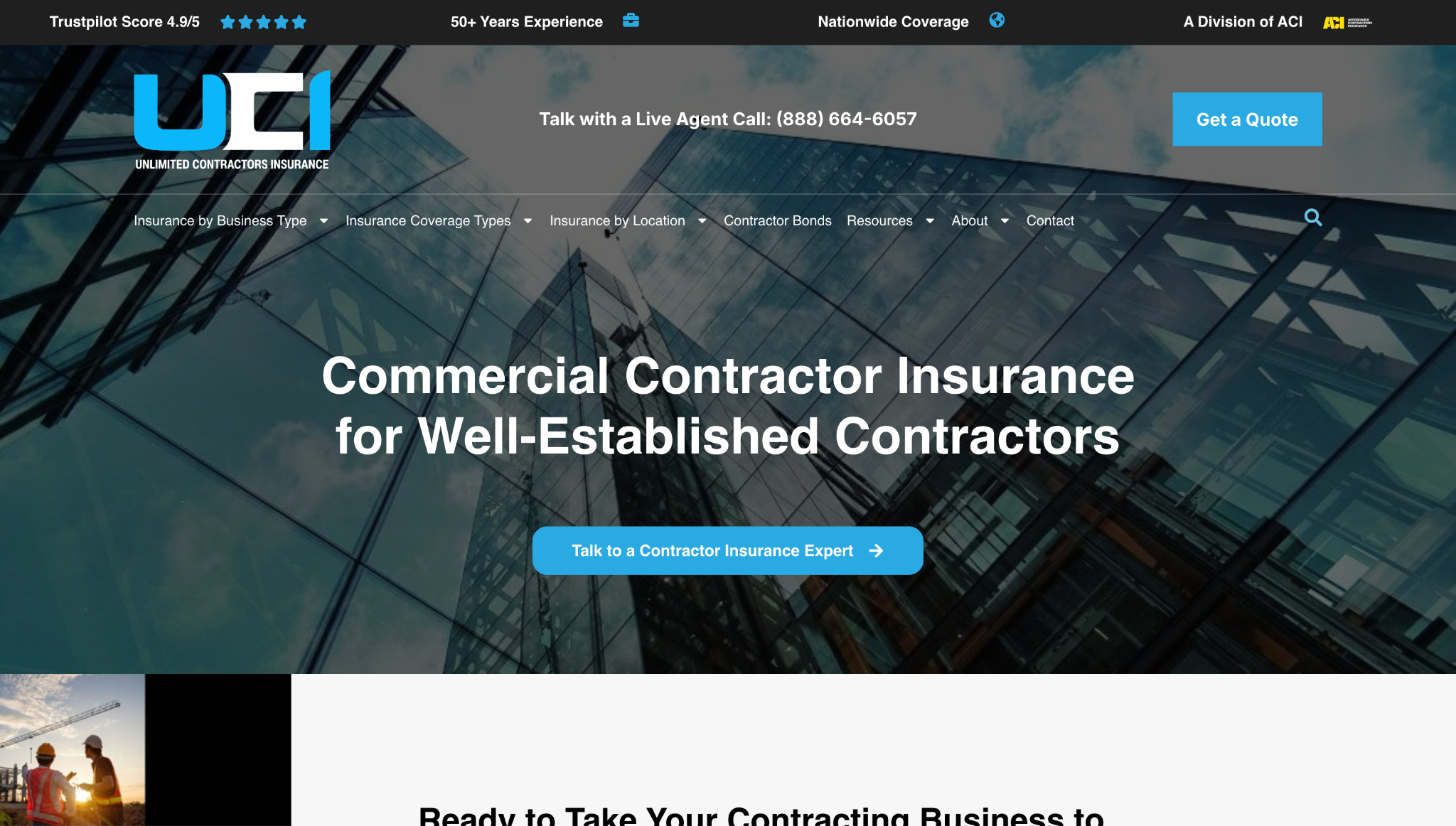
What Does Unlimited Contractors Insurance Do?
Unlimited Contractors Insurance runs as a premium brokerage built for established construction companies. They cover general liability, workers’ compensation, commercial auto, builder’s risk, umbrella and excess liability, property and casualty, tools and equipment, and wrap-up programs like OCIP and CCIP. What separates them from standard brokers is their private-client service model. Each client gets a dedicated insurance advisor focused on strategic risk planning, not just policy placement. That kind of support is rare in a space where most brokers hand you a policy and move on.
Why Unlimited Contractors Insurance Stands Out as an Insurance Provider:
Construction companies with multi-state operations and large project portfolios need more than off-the-shelf coverage. That’s exactly the gap Unlimited Contractors Insurance fills. Based on the data, their dedicated advisor model directly reduces exposure to complex projects where generic policy language tends to fall short.
Summary of Real User Reviews:
Public review data for Unlimited Contractors Insurance isn’t widely available yet, which tracks for a premium brokerage that works with a select client base rather than volume. Clients in this segment tend to prioritize relationship quality and claims reliability over online review counts (not a knock, just how enterprise-level service tends to work). The private-client model suggests outcomes are measured through retention and referrals rather than public platforms.
2. Daniel Poe State Farm – Best for Small to Medium Business Contractors Insurance

What Does Daniel Poe State Farm Do?
Daniel Poe State Farm is a local agency based in Dallas, Georgia, serving contractors and small businesses across the surrounding metro area, including Marietta, Kennesaw, and Douglasville. They offer the full State Farm commercial lineup, including general liability, surety bonds, professional liability, group life insurance for teams of five or more, and business property coverage. What works in their favor is the combination of a major national carrier’s financial backing with actual local agent access. You’re not calling a 1-800 number (which matters more than people admit when a claim hits).
Why Daniel Poe State Farm Stands Out as an Insurance Provider:
Local agencies backed by national carriers solve a specific problem: personalized service without sacrificing financial stability or coverage depth. Their text-based communication option signals genuine attention to how small business owners prefer to interact, quickly and without bureaucracy.
Summary of Real User Reviews:
Standalone public reviews for this specific agency are limited, which is common for local State Farm offices. State Farm’s broader commercial insurance ratings reflect solid claims support and financial strength, though smaller contractors sometimes note that State Farm products can feel more standardized than specialty construction brokers offer. That’s worth weighing depending on your project scope.
3. Progressive Commercial Insurance – Best for Commercial Auto Insurance for Construction Fleets
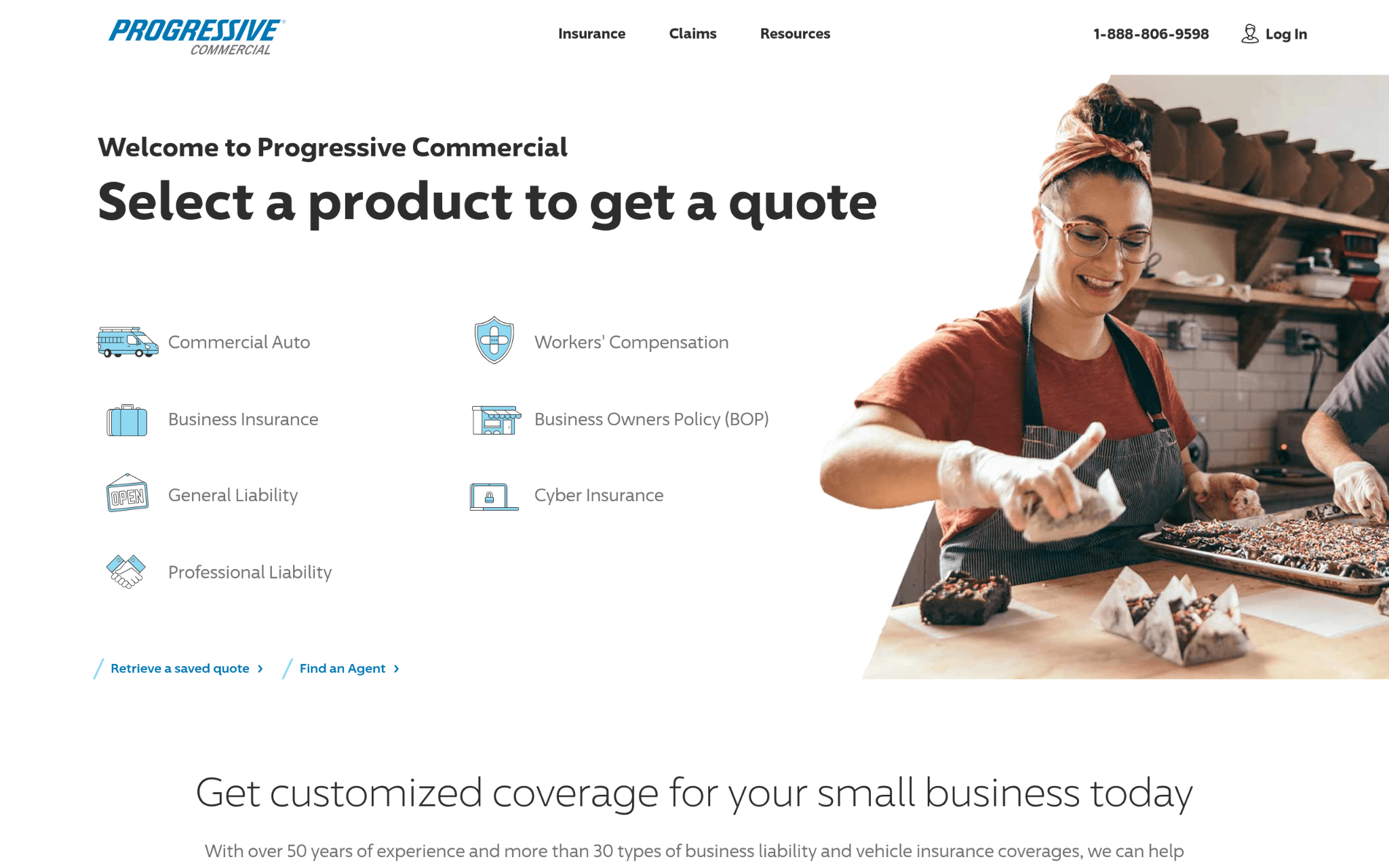
What Does Progressive Commercial Insurance Do?
Progressive Commercial holds the top spot as the number one commercial auto insurer in the United States. They’ve been at it since 1971 and currently cover more than one million commercial vehicles for small businesses across 49 states. Their coverage lineup includes commercial auto, general liability, workers’ compensation, business owners policies, professional liability, and cyber insurance. They also run Snapshot ProView, their own custom telematics tool for fleet tracking and risk scoring.
For construction companies running multiple vehicles and equipment haulers, that combination of fleet coverage and data-backed risk tools is genuinely useful. Honestly, no other provider on this list comes close to the depth for commercial vehicles.
Why Progressive Commercial Insurance Stands Out as an Insurance Provider:
Managing fleet exposure across a large construction operation requires both pricing flexibility and real-time risk visibility. Progressive Commercial delivers both through competitive monthly pricing and its Snapshot ProView platform. Their A+ rating from A.M. Best and consistent financial strength ratings from Standard and Poor’s and Moody’s back up their ability to pay claims reliably.
Summary of Real User Reviews:
Progressive Commercial earns strong marks for pricing transparency and ease of policy management. Reviews from small business owners consistently point to the online quoting process as a standout, though some contractors in heavier construction niches note that general liability coverage feels less customized than a specialty broker would offer. Their recognition as the top insurer of non-fleet trucks speaks to real market trust in the commercial vehicle space.
4. Federated Insurance – Best for Industry-Specific Property and Casualty Coverage
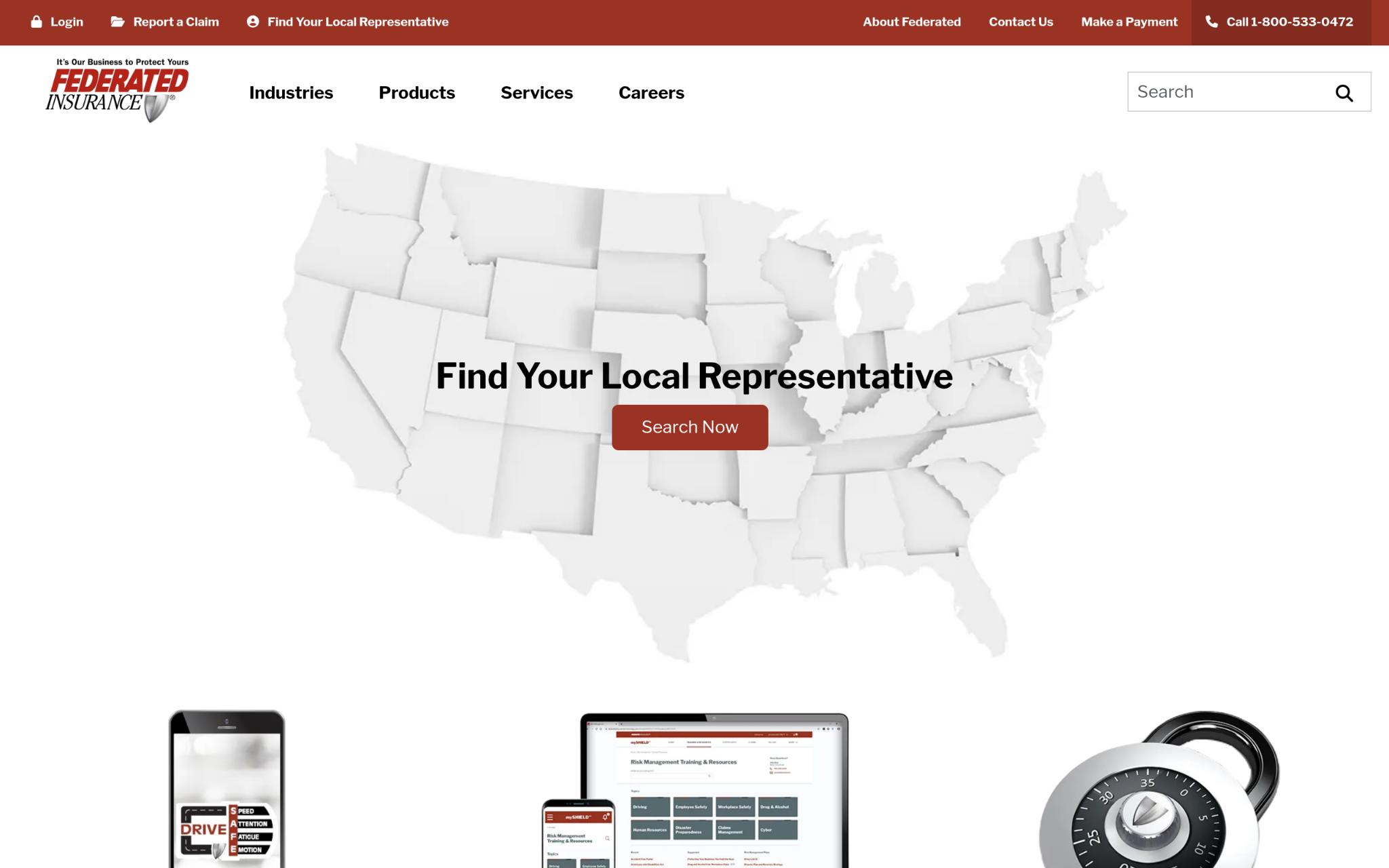
What Does Federated Insurance Do?
Federated Insurance has been running as a mutual insurance company since 1904 (yes, over 120 years). They offer property and casualty coverage, workers’ compensation, life and disability, surety and bonding, and business succession planning across 49 states. What sets their model apart is its mutual ownership structure. As a policyholder-owned company, they reinvest gains back to clients rather than to outside shareholders. They also maintain partnerships with over 500 state, regional, and national trade associations, which gives them genuine industry credibility.
Their Federated DriveSAFE telematics tool mirrors what Progressive offers on the fleet side, but Federated’s broader specialty focus on contractors and manufacturers gives them a different kind of depth.
Why Federated Insurance Stands Out as an Insurance Provider:
Policyholder-owned insurers don’t face pressure from outside investors, and that structural difference tends to show up in how claims get handled and how proactively the company works on loss reduction. Holding an A+ (Superior) rating from A.M. Best for 27 consecutive years is the kind of consistency that’s genuinely hard to replicate.
Summary of Real User Reviews:
Federated Insurance’s reviews and recognition lean heavily on employer reputation, with Forbes naming them a Best-in-State Employer in 2025 and Newsweek listing them as a Most Admired Workplace in 2026. Client-facing reviews point to their proactive risk management approach, particularly the employee training and hazard control programs. Some smaller contractors note that Federated’s model works better for established businesses with longer operating histories, which tracks given their specialty focus.
5. InsuredBetter – Best for Business Insurance Comparison and Agent Matching
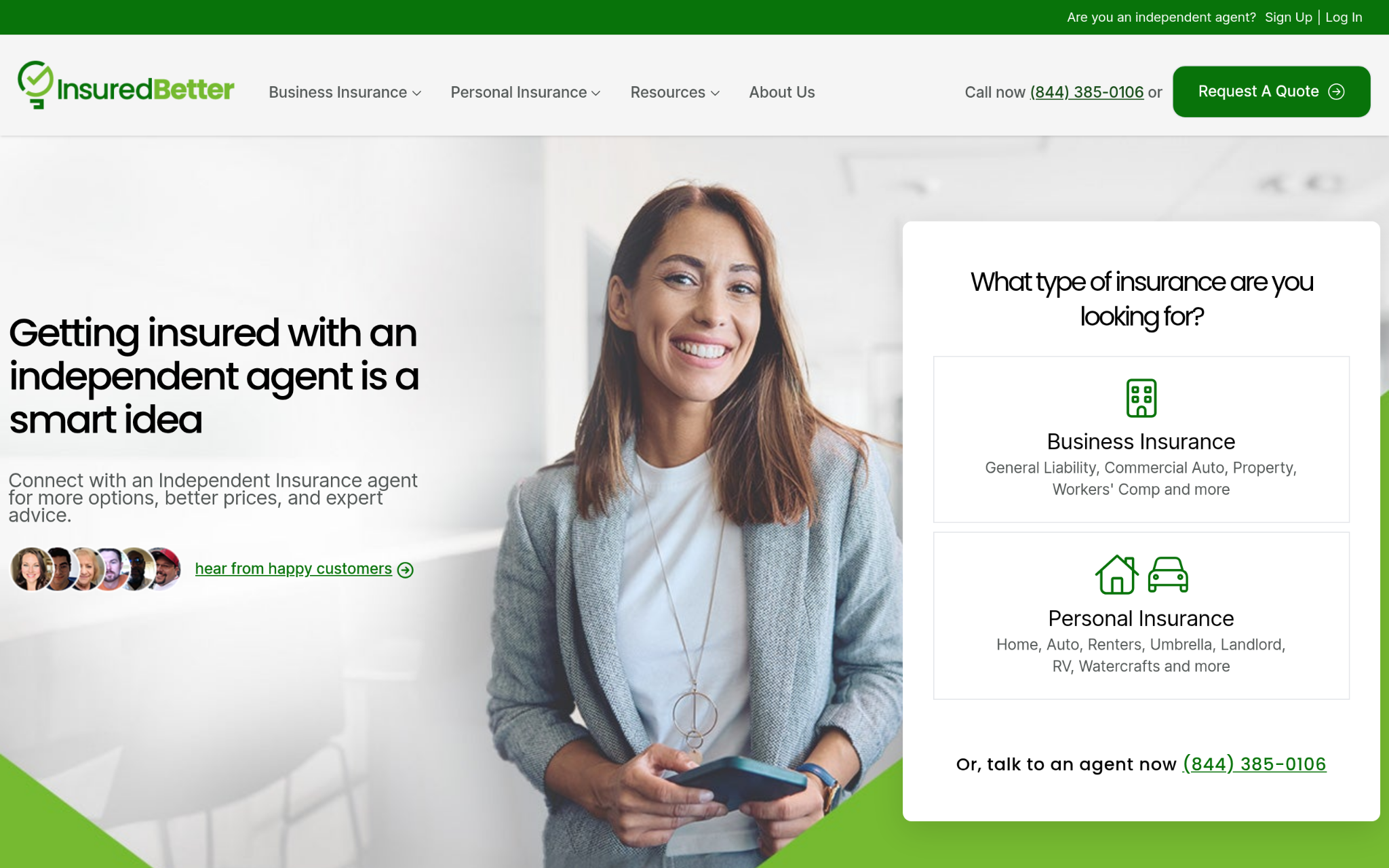
What Does InsuredBetter Do?
InsuredBetter works as a marketplace platform rather than a direct insurer. They connect consumers and small business owners with local, independent agents who can pull quotes from multiple carriers at once. Coverage categories include workers’ compensation, general liability, professional liability, business owners’ policies, cyber liability, and personal lines like auto and home.
Because they work with independent agents rather than captive agents, users get genuine carrier comparison rather than a single company’s options. For contractors still in the early stages of building their insurance program, that kind of side-by-side visibility is worth a lot. The platform generates revenue through carrier and agent affiliate relationships, so the service costs nothing to the end user.
Why InsuredBetter Stands Out as an Insurance Provider:
Independent agent platforms remove a real friction point in insurance shopping: the captive agent’s built-in incentive to sell you one carrier’s products regardless of fit. Connecting buyers to agents with multi-carrier access leads to more competitive pricing and better coverage alignment than single-carrier shopping typically produces.
Summary of Real User Reviews:
Public review data specific to InsuredBetter’s platform is limited. The marketplace model itself tends to earn positive feedback for quote speed and the ability to compare across carriers in one place. Contractors with more involved, multi-line needs may find the agent matching works better as a starting point than as a final solution, since the depth of specialized construction knowledge varies depending on which local agent gets matched.
Research Methodology and Selection Process
Initial Data Collection
The starting point for this ranking was a broad scan across insurance directories, trade association listings, commercial insurance review platforms, and the official websites of providers known to serve the construction sector. Priority went to companies with publicly accessible information about their coverage options, carrier relationships, and client focus. Providers that lacked any verifiable construction-specific information were excluded from further evaluation.
Shortlisting Phase
From the initial pool, options with inconsistent or unverifiable information were filtered out. Review patterns across multiple platforms were analyzed to spot service quality signals, including how frequently construction-specific claims experiences were mentioned, how clients described the communication process, and whether any recurring complaints pointed to widespread problems. Only providers with a traceable and consistent pattern of serving contractors or commercial construction clients moved forward.
Verification of Claims
Each company’s stated capabilities were cross-referenced with third-party sources, including industry ratings from A.M. Best, NAIC complaint data when available, and publicly available award mentions. Where a provider made specific claims about their financial strength or market position, those claims were checked against the sources they referenced. Discrepancies between marketing language and verified data were flagged and factored into final placement decisions.
Authority and Industry Contribution Layer
Recognition from credible external sources carried real weight in this evaluation. A.M. Best financial strength ratings, Ward Group performance acknowledgments, FORTUNE recognition, and verified trade association partnerships all contributed to a provider’s overall credibility score. This layer helped distinguish providers with genuine industry standing from those with polished websites but little third-party validation. Federated’s 27-year streak at A+ from A.M. Best and Progressive’s consistent financial ratings are good examples of the kind of sustained authority that held up under scrutiny.
Insurance Providers-Specific Evidence
The final layer focused on construction industry fit. Each provider was assessed for dedicated contractor-focused service pages, coverage types built around construction risks (builder’s risk, OCIP/CCIP, tools and equipment, surety bonds), and verified client experiences from the construction sector. Providers offering only generic commercial coverage without a construction-specific context scored lower on this dimension. The goal was to surface options that actually understand the risks contractors face day to day, not just providers that technically offer a business policy.
How to Choose the Right Insurance Providers
The right insurance partner for a construction company comes down to more than price. Coverage fit, claims reliability, and genuine industry knowledge all factor in. Here’s what to evaluate before committing.
- Industry and Domain Experience: Look for providers with documented construction experience, not just general commercial coverage. Specialized knowledge shows up in policy language, coverage options like builder’s risk or wrap-up programs, and the quality of risk advice you receive.
- Features and Service Options: A strong insurance partner for contractors should cover general liability, workers’ comp, commercial auto, and umbrella coverage at a minimum. Specialty programs like OCIP/CCIP or tools and equipment coverage indicate real depth.
- Pricing Structure: Monthly premium ranges vary widely based on project size, payroll, and claims history. Get multiple quotes and compare not just price but what each policy actually includes and excludes.
- Results Measurement: Ask about claims settlement ratios and average processing times before signing. A carrier with a strong A.M. Best rating and a low NAIC complaint index ratio is generally a safer bet for payout reliability.
- Industry Knowledge and Licensing: Confirm the provider is licensed in every state where your projects operate. State DOI regulations and NAIC standards vary, and gaps in licensing can leave you exposed on out-of-state jobs.
Bottom Line
Construction companies with real revenue at stake need insurance partners that can match that scale. Unlimited Contractors Insurance leads this list for enterprise-level contractors needing dedicated advisory support and specialty programs. Progressive Commercial and Federated bring strong financial ratings and niche knowledge. Daniel Poe State Farm and InsuredBetter serve contractors at earlier stages. As project sizes grow and multi-state work becomes standard, the gap between generic coverage and specialty programs will keep widening.