
HIPAA violations don’t announce themselves ahead of time, and that’s exactly why the best HIPAA compliance services matter more than most healthcare organizations realize until something goes wrong. Managing Business Associate Agreements across dozens of vendors, keeping pace with OCR enforcement updates, and running a defensible Security Risk Analysis are not tasks you can wing. After reviewing platforms, consulting firms, and GRC tools across the healthcare compliance space, this guide covers five options worth your serious attention.
How this ranking was put together
Each option was assessed using publicly available information pulled from review platforms, official product pages, case studies, and compliance review directories. Only companies with a documented track record in healthcare compliance made the cut.
→ See the full research breakdown
- ComplyAssistant – Best for healthcare organizations seeking HIPAA compliance and cybersecurity consulting
- Secureframe – Best for fast-growing businesses seeking automated compliance and security certifications
- HealthStream – Best for healthcare workforce development and compliance training
- MetricStream – Best for enterprise GRC and compliance management
- Sprinto – Best for healthcare and enterprise compliance automation
- Why HIPAA Compliance Services Are Worth a Closer Look
- Comparing the 5 Best HIPAA Compliance Services
- 1. ComplyAssistant – Best for Healthcare Organizations Seeking HIPAA Compliance and Cybersecurity Consulting
- 2. Secureframe – Best for Fast-Growing Businesses Seeking Automated Compliance and Security Certifications
- 3. HealthStream – Best for Healthcare Workforce Development and Compliance Training
- 4. MetricStream – Best for Enterprise GRC and Compliance Management
- 5. Sprinto – Best for Healthcare and Enterprise Compliance Automation
- Methodology Behind These Picks
- Picking the Right HIPAA Compliance Services for You
- The Verdict
Related Articles
-
 Update: Will the DOL’s new exempt employee rules be delayed…
-
New Overtime Law Changes and HR Guidance in April 2024
-
Mental Health in the Workplace: Legal Obligations and Best Practi…
-
Handling of Final Pay Checks and Unpaid Compensation Upon Death o…
-
What the Law Says About Personal Internet Usage at Work
-
How to Overcome Communication Challenges in Your Remote Teams
-
Workplace Harassment 101: Understanding Its Types, Signs, and Imp…
-
7 Critical Employment Law Updates You Need in 2024
-
Digital Accessibility for Remote Work: 10 Key Tips
-
Decoding Workplace Drug Testing: Legal, Ethical, and Privacy Pers…


Why HIPAA Compliance Services Are Worth a Closer Look
Picking the right service in this space directly shapes how your organization handles real pressure points.
Keeping up with shifting HIPAA, HITECH Act, and state-level healthcare privacy laws takes more than occasional policy reviews. OCR enforcement guidance changes, and organizations that aren’t tracking those changes carefully tend to find out the hard way.
Managing Business Associate Agreements across large vendor networks adds another layer of challenge. One unexecuted agreement can expose your entire program.
Well-chosen services address both problems by building structure around what’s often improvised. That structure shows up in measurable ways: stronger Security Risk Analysis completion rates, higher employee HIPAA training comprehension scores, and a fully documented inventory of active Business Associate Agreements. Those aren’t just compliance checkboxes. They’re proof points that matter when OCR comes knocking.
Comparing the 5 Best HIPAA Compliance Services
Note: All data in this table is sourced from review platforms and the official websites of the listed companies.
| Company Name | Years Operating | Team Size | Headquartered In |
| ComplyAssistant | Since 2002 | 11-50 | Woodbridge, New Jersey |
| Secureframe | Since 2020 | ~200 | San Francisco, California |
| HealthStream | Since 1990 | ~1,093 | Nashville, Tennessee |
| MetricStream | Since 1999 | ~1,266 | San Jose, California |
| Sprinto | Since 2020 | ~316 | San Francisco, CA / Bangalore, India |
1. ComplyAssistant – Best for Healthcare Organizations Seeking HIPAA Compliance and Cybersecurity Consulting
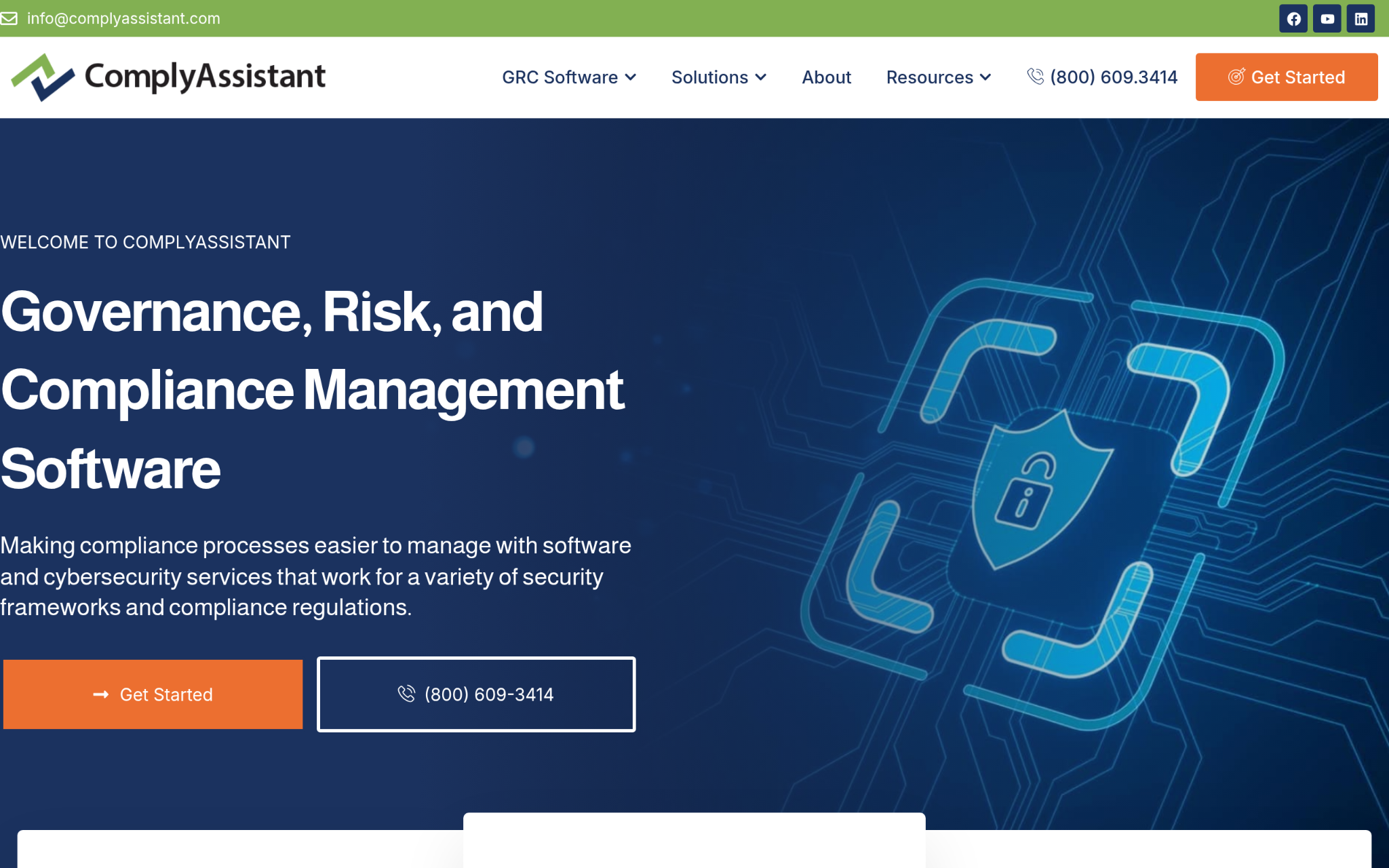
How Does ComplyAssistant Operate?
Founded in 2002 and based in Woodbridge, New Jersey, ComplyAssistant works exclusively in the healthcare compliance space. Their team offers GRC software and consulting services covering security audits, risk assessments, virtual CISO support, and vendor risk management. Organizations that work with their team as HIPAA consultants get both a software platform and hands-on guidance, which is a genuinely rare combination at a flat-rate price point of $5,000 per year. They serve over 100 healthcare clients and carry endorsement from HASC across HIPAA, HITECH, HITRUST, NIST, and PCI frameworks.
Why Does ComplyAssistant Stand Out for HIPAA Compliance Services?
The gap they fill is the one between compliance software that tracks issues and expert guidance that actually fixes them. That combination of a purpose-built healthcare platform and 22-plus years of focused industry experience is hard to match, especially at this price range.
What Users Are Actually Saying:
Clients consistently point to responsiveness and deep healthcare-specific knowledge as standout qualities. ComplyAssistant earned 2025 GetApp Category Leader recognition in HIPAA Compliance, and organizations like HackensackUMC Palisades and Cape Regional Health System are on their client list, which builds real trust. Honestly, for a team their size, that’s an impressive footprint.
2. Secureframe – Best for Fast-Growing Businesses Seeking Automated Compliance and Security Certifications
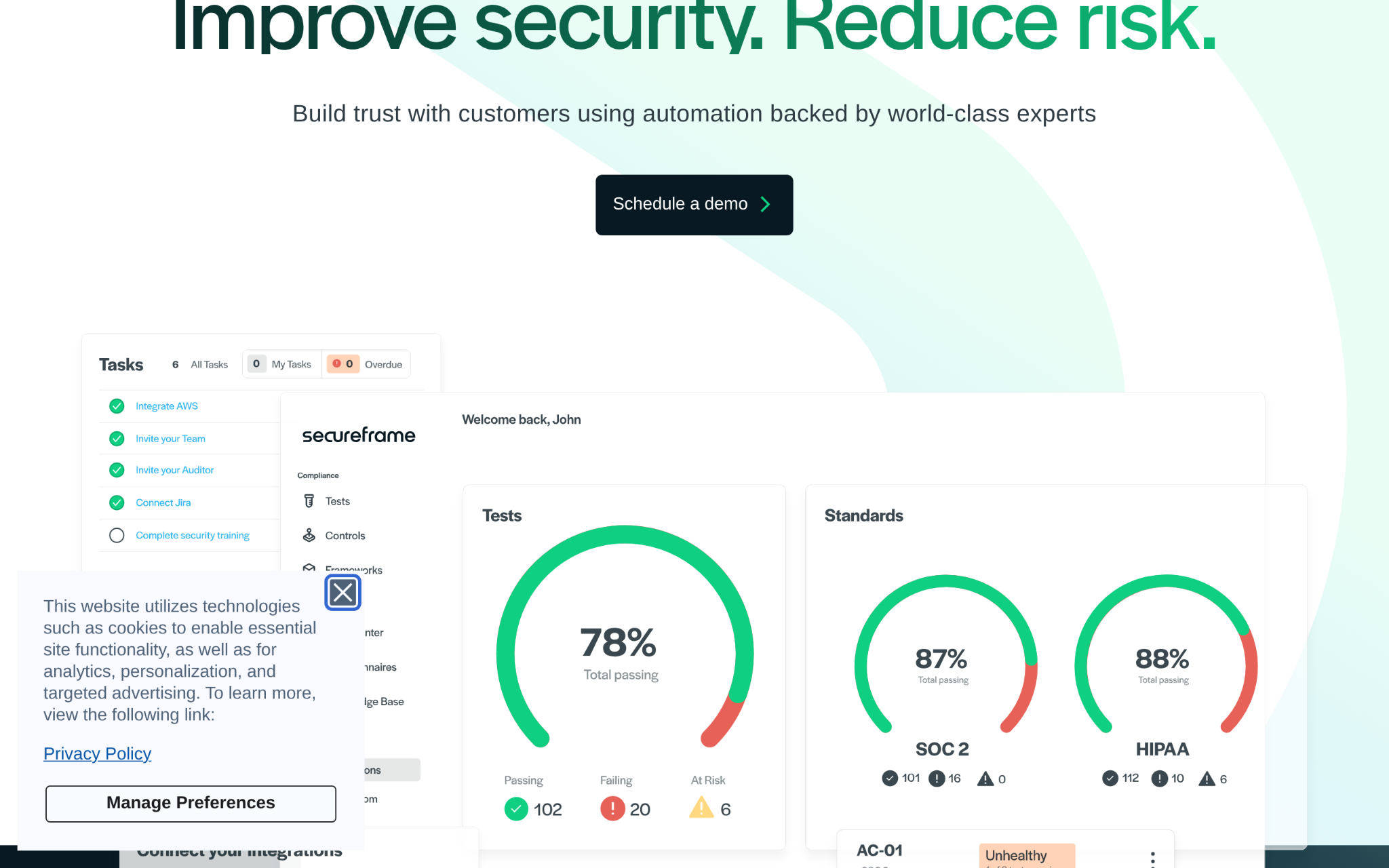
How Does Secureframe Operate?
Secureframe launched in 2020 and is based in San Francisco. It automates the compliance certification process across frameworks including SOC 2, ISO 27001, PCI DSS, HIPAA, and GDPR. The platform handles evidence collection, policy management, risk tracking, and continuous monitoring through over 100 integrations. What sets their setup apart is that every customer gets assigned a dedicated compliance expert, and those experts are former auditors, not generalists, which makes a real difference when audit queries get technical.
Why Does Secureframe Stand Out for HIPAA Compliance Services?
Secureframe goes after the timeline problem directly. Teams that would otherwise spend months on manual evidence gathering can compress that work through their automation layer. Their recognition as a G2 Leader across five categories and a 2025 Cyber Defense Magazine award at RSA signals that the market has validated their approach well beyond marketing claims.
What Users Are Actually Saying:
Customers consistently mention how much time the automation saves during audit preparation. Having a former-auditor contact rather than a general support rep makes the compliance process feel less like guesswork and more like a structured path. That kind of expert access is rare at this scale.
3. HealthStream – Best for Healthcare Workforce Development and Compliance Training
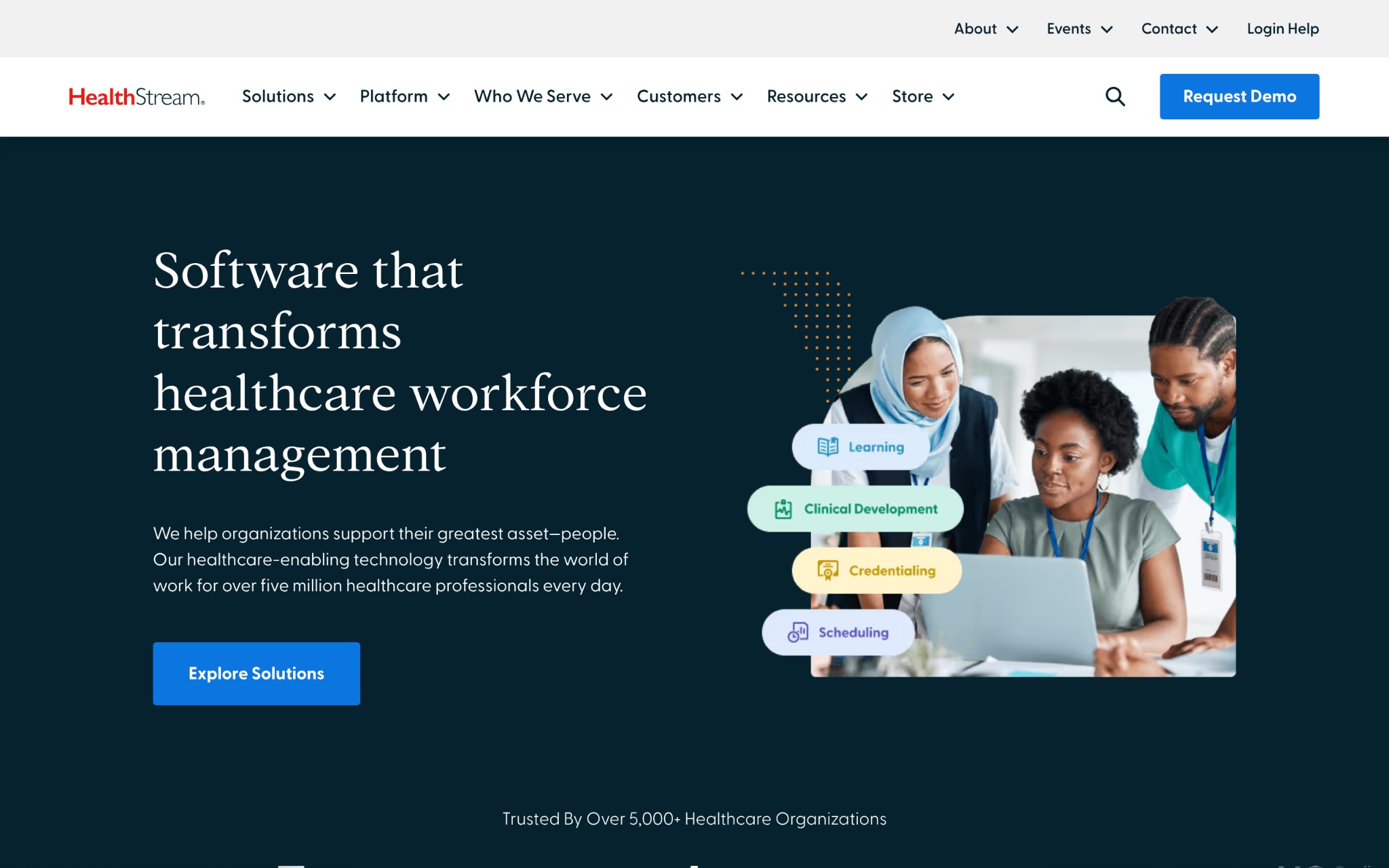
How Does HealthStream Operate?
HealthStream has been running since 1990 out of Nashville, Tennessee. They serve over 5,000 healthcare customers and more than 5.5 million healthcare professionals, covering more than 70% of all U.S. hospital systems. Their SaaS platform addresses workforce development, training compliance, talent management, credentialing, and performance assessment through products like SafetyQ and ComplyQ. For healthcare organizations where staff HIPAA training completion rates are a constant pressure point, HealthStream was built to solve exactly that problem at scale.
Why Does HealthStream Stand Out for HIPAA Compliance Services?
Most compliance platforms track policy documents. HealthStream built their entire model around the people side of compliance, with training completion and credentialing across large, distributed workforces. That focus tends to produce stronger employee HIPAA training comprehension scores for organizations that use them consistently across departments.
What Users Are Actually Saying:
Users frequently point to the breadth of content and how well the platform scales across large health systems. Earning more Top 50 placements on G2’s 2026 Best Healthcare Software list than any other vendor is not a small thing in a space this crowded. Multiple Brandon Hall Excellence in Technology Awards back that up further.
4. MetricStream – Best for Enterprise GRC and Compliance Management
How Does MetricStream Operate?
MetricStream was founded in 1999 and is headquartered in San Jose, California. The company builds GRC platforms for large enterprises across banking, healthcare, energy, insurance, and life sciences. Their AI-first cloud platform covers risk management, compliance automation, internal audit, third-party risk, and resilience management. The platform’s low-code and no-code capabilities are designed to cut repetitive GRC tasks by 80 to 90%, which matters a lot for healthcare compliance teams stretched thin across internal IT and legal resources. Think enterprise pricing, but with enterprise-level depth to match.
Why Does MetricStream Stand Out for HIPAA Compliance Services?
Large healthcare organizations managing intricate, multi-framework compliance programs often need something that goes beyond point-in-time assessments. MetricStream’s continuous monitoring and automated compliance management directly address that need. Being ranked a Leader across all five domains in Chartis Research’s 2025 GRC Solutions report puts them in a small group of platforms that can credibly claim that kind of breadth.
What Users Are Actually Saying:
Enterprise users tend to value the depth of the audit and risk modules most. Over 1 million GRC professionals globally work on their platform, which gives it a kind of weight that newer tools haven’t earned yet. Users in regulated industries call out the audit trail quality as a real differentiator.
5. Sprinto – Best for Healthcare and Enterprise Compliance Automation
How Does Sprinto Operate?
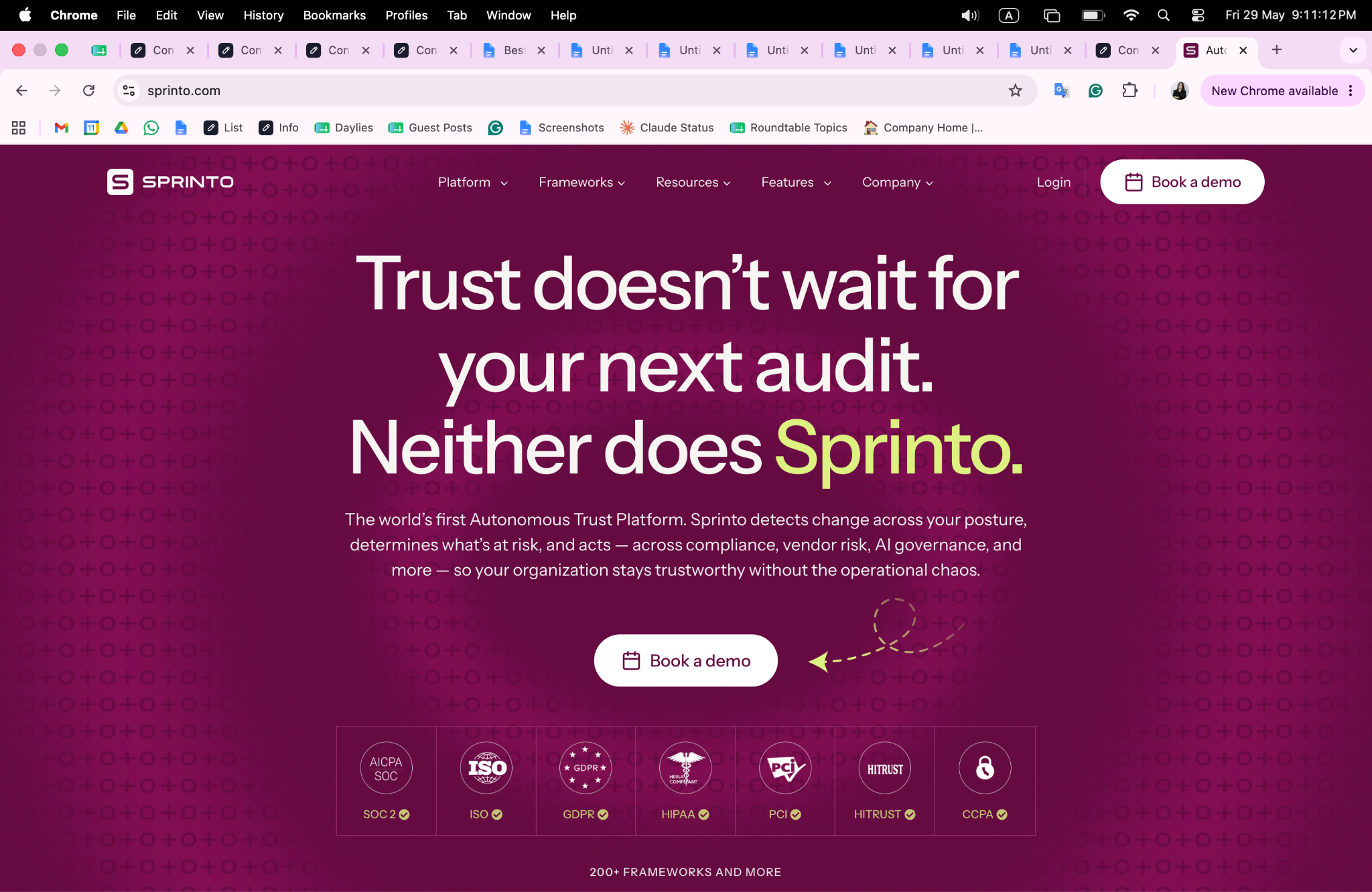
Sprinto launched in 2020 and operates out of San Francisco and Bangalore. They describe themselves as the world’s first Autonomous Trust Platform, and the distinction matters. Rather than alerting teams to compliance gaps, Sprinto actively closes them and refreshes evidence automatically. Their platform covers 200-plus global standards including HIPAA, SOC 2, ISO 27001, GDPR, and PCI-DSS, with over 300 integrations. They serve 3,000-plus companies across 75 countries and have grown their team by 63% year-over-year, backed by $32.2 million in funding.
Why Does Sprinto Stand Out for HIPAA Compliance Services?
Teams that have historically relied on manual evidence collection for HIPAA audits will notice the difference fast, because Sprinto’s automation doesn’t just track things. It executes. That proactive posture is especially useful for demonstrating ongoing compliance rather than scrambling for documentation at audit time.
What Users Are Actually Saying:
Sprinto holds a 4.8-star rating on G2, and customer feedback consistently points to speed as the standout quality. Clients like Fyle reached SOC 2 compliance in under 30 days, and Apty completed ISO 27001 certification in two weeks. That kind of result is hard to dismiss as a marketing story when the review patterns line up this clearly.
Methodology Behind These Picks
Gathering Baseline Information
The starting point was building a broad list of candidates from multiple directions at once. Healthcare compliance directories, professional association resources, software review platforms, and published case studies were all pulled together to identify which companies showed up repeatedly when healthcare organizations discussed HIPAA regulatory adherence. The goal at this stage was breadth, not judgment. Every name that surfaced with credible mentions across more than one source type made the initial list, regardless of company size or service model.
The Shortlist Cut
Once the initial list was assembled, options without verifiable track records in healthcare compliance were removed. This wasn’t just about filtering out unrelated vendors. It also meant examining review patterns closely. Companies with generic compliance products that touched HIPAA only peripherally were separated from those where healthcare compliance was clearly central to their work. Review volume, recency, and the detail level of feedback all factored into which names moved forward and which ones didn’t.
Fact-Checking the Picks
Every shortlisted company was cross-referenced against what their official website claimed versus what actual users reported. Service pages were checked against user reviews to spot gaps between marketing language and real-world experience. Where case studies existed, those were read against review platform feedback to see whether the types of results being claimed matched the patterns showing up organically from clients. Discrepancies flagged during this stage led to closer scrutiny or removal from the list.
Authority Signals and Industry Standing
Third-party audit validations, industry certifications, award recognitions, and mentions in healthcare and compliance publications were all factored into the final assessment. A company’s reputation is partly built on what peers and independent evaluators say about them, so placements on recognized software rankings, analyst report findings, and association endorsements all carried weight here. The goal was to confirm that the companies on this list have earned standing in the broader healthcare compliance community, not just self-reported it.
HIPAA Compliance Services Track Record
The final check focused on whether each company had dedicated service pages, documented healthcare client relationships, and verifiable results tied to HIPAA regulatory adherence. General compliance tools were distinguished from healthcare-specific ones based on the depth of their HIPAA coverage, the specificity of their case study language, and whether their reviews came from covered entities and business associates rather than unrelated industries. Companies that cleared all five stages of this process made the final list.
Picking the Right HIPAA Compliance Services for You
The right service for a large hospital system looks different from what a small clinic or a business associate needs. Here’s what to actually weigh before committing.
- Industry and Domain Experience: Look for providers with documented work in healthcare specifically, not just general compliance experience. Covered entity classifications and PHI handling restrictions require specialized knowledge that only comes from years inside the space.
- Features and Service Offerings: Match the feature set to your actual gaps. If your organization struggles with Security Risk Analysis completion rates, prioritize platforms built around structured SRA workflows. If training compliance is the problem, workforce-focused tools like HealthStream make more sense.
- Pricing Structure: Be realistic about the total cost of your compliance program versus the potential cost of OCR findings. Flat-rate models like ComplyAssistant’s $5,000 per year offer predictability. Automation-heavy platforms may carry higher price tags but reduce internal labor costs.
- Results Measurement: Ask how each provider measures success. The best services tie their outputs to concrete metrics like the number of resolved compliance gaps, mean time to detect a PHI breach, and OCR audit readiness scores.
- Industry Knowledge and Compliance: A provider’s understanding of HIPAA, HITECH Act, and state-level healthcare privacy laws should be visible in their documentation, their team credentials, and the specificity of their client results.
The Verdict
HIPAA compliance isn’t a one-time project, and the service you choose needs to reflect that. ComplyAssistant brings 22-plus years of focused healthcare experience at a price point that works for most organizations. Secureframe and Sprinto address the automation side well. HealthStream owns the training and workforce angle. MetricStream fits large enterprises with complex GRC needs. As OCR enforcement continues to mature, the organizations that build continuous compliance programs now will be the ones better positioned when it counts.