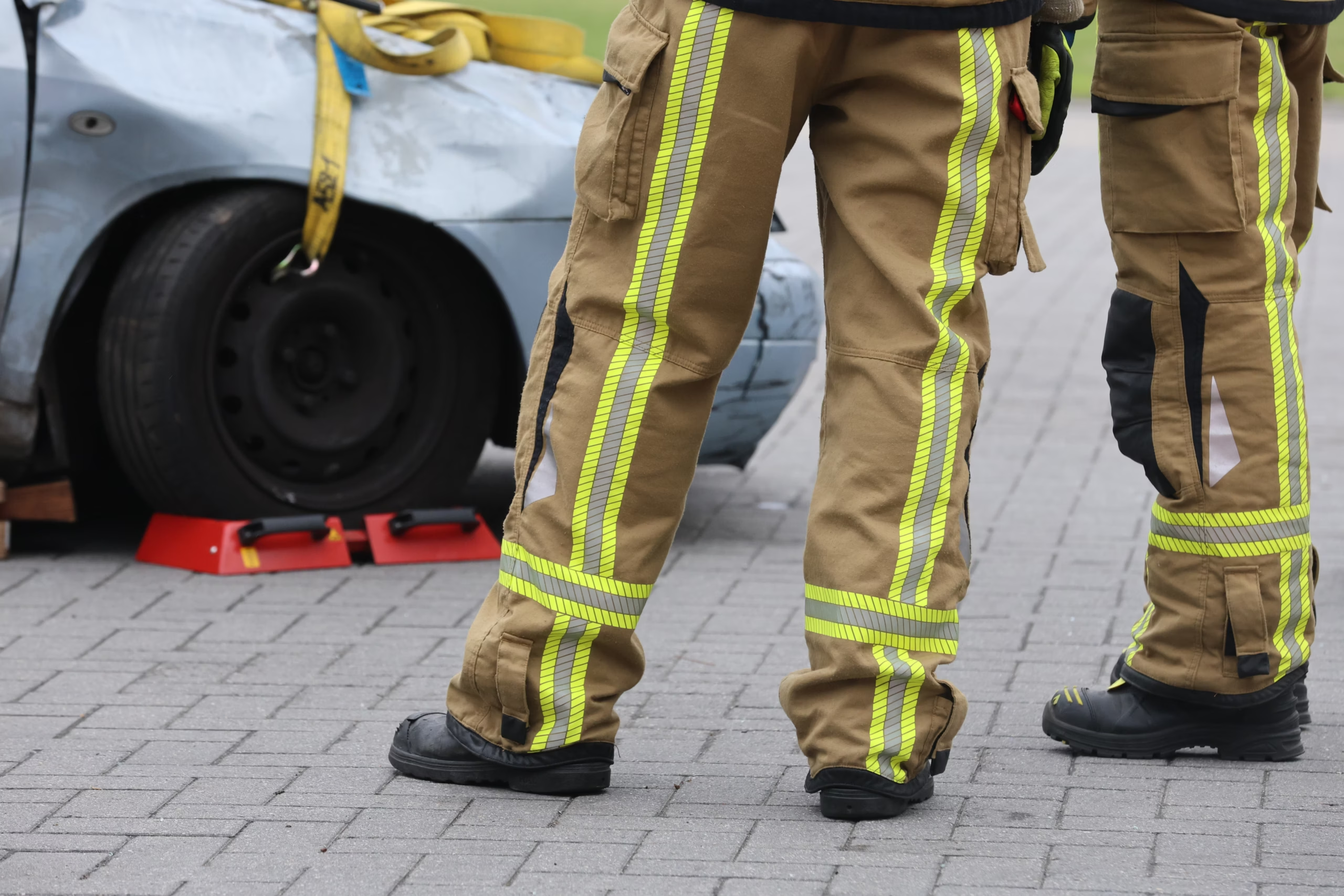
Typically, workers’ compensation claims occur when the injured employee was working in the course and scope of their employment. However, what if someone who isn’t an employee causes an on-site injury?
Far more often than most people realise it occurs. A delivery driver backs into a warehouse worker. A subcontractor drops a wrench off scaffolding. A brand new piece of equipment crushes a hand.
In each of those incidents someone not on payroll caused the damage.
And the totals aren’t tiny. The latest federal data shows there were 5,070 fatal workplace injuries in 2024. That’s one worker killed about every 104 minutes. Private sector employers also reported 2.5 million injury and illness cases that same year.
Here’s the problem…
Workers’ compensation covers medical bills and a portion of lost wages. That’s all. It doesn’t cover grief, it doesn’t come close to filling the financial crater a family experiences, and it pales in comparison to what a wrongful death claim can recover when a negligent outside company is responsible for the accident. Bridging that gap is the exact purpose of third party injury lawsuits. If a worker is killed because a contractor failed to follow safety protocols or a manufacturer sold them a defective machine, the surviving family can file a wrongful death claim against that third party and seek damages the workers’ comp system cannot.
Let’s break the whole thing down…
Here’s what’s coming up:
- Who Actually Counts As A “Third Party”
- Why Workers’ Comp Is Only Half The Story
- The Accidents That Usually Involve Somebody Else
- How A Wrongful Death Claim Works Against A Third Party
- Evidence, Deadlines & Costly Mistakes


Who Actually Counts As A “Third Party”?
Any person or business involved in the accident that is not your employer or a co-worker. Period.
The problem is that jobsites are busy places. Step onto a medium-sized construction job and there may be six different companies operating there simultaneously, each with it’s own insurance policy.
The usual suspects include:
- Subcontractors and their crews
- Equipment and machinery manufacturers
- Property owners and landlords
- Delivery drivers and haulage firms
- Maintenance, cleaning and security contractors
- Chemical suppliers
What most families never discover is this. The company may have done absolutely nothing wrong. Training may have been signed off. Safety briefing may have occurred that morning. And still a worker dies because somebody else’s driver ran a stop sign in the yard.
It’s a third party lawsuit. It proceeds on its own track separate from the workers’ comp claim.
Why Workers’ Comp Is Only Half The Story
Workers’ comp was a compromise. Employees injured on the job are paid quickly, without having to prove anyone was negligent. In return, they lose the right to sue their employer.
Fair enough. But that trade-off only covers the employer.
It does not indemnify the outside company who was negligent and caused the accident. Those companies can be held totally liable.
A third party wrongful death claim can recover things comp simply doesn’t offer:
- Full lost earnings, both past and future
- Loss of benefits, pension and household services
- The pain and suffering the worker went through before death
- Loss of companionship, guidance and support
- Funeral and burial costs
- Punitive damages where the conduct was truly reckless
There’s a huge difference. Comp death benefits are determined by a formula. And they are limited by state law. A wrongful death claim is based upon what your family actually lost. It’s a much different number.
Just a note. The comp insurer will typically lien any third party recovery to recoup what it paid. That doesn’t resolve the claim, you just need to deal with that.
The Accidents That Usually Involve Somebody Else
Not all workplace injuries involve a third party. However, some common types repeat themselves:
Transportation-related incidents accounted for the largest share of fatal work injuries during that 2024 federal census year, representing over a third of deaths. Vehicles involve outside drivers, companies and insurance policies.
Watch for these scenarios:
- Vehicle strikes, related to site — trucks or visitors colliding with pedestrian workers
- Defective equipment — a machine, ladder, harness or power tool that malfunctioned due to poor design or construction
- Falling objects — tools dropped by a crew from another company working overhead
- Unsafe premises — a premises owner who failed to maintain a loading dock or stairwell in safe condition
- Chemical exposure — a supplier sent a container with an incorrect label on it or shipped it with no warnings
Do you notice a trend? Almost all of them resulted from someone who visited the page, acted negligently, and moved on.
How A Wrongful Death Claim Works Against A Third Party
A wrongful death claim is a lawsuit brought by the family following a fatal accident. States determine who can sue, although it is typically the spouse, children, parents, or the representative of the estate.
To win, four things need to be established:
- The third party owed a duty of care to people on that site
- They breached it through careless or reckless behaviour
- That breach directly caused the fatal accident
- The family suffered real, measurable losses
The threshold of proof is much lower than at a criminal trial. Nothing needs to be proven beyond reasonable doubt — the case simply needs to prove that it’s more likely than not that the third party’s negligence caused the death.
Evidence, Deadlines & Costly Mistakes
Here’s the part that decides most of these cases…
Evidence doesn’t last long. Work sites are cleaned up in hours. Damaged equipment is fixed, replaced or discretely removed. Witnesses go to another job and can’t be located.
The evidence worth locking down straight away:
- Photographs of the scene, the equipment and the conditions
- The company incident report and any OSHA findings
- Names and contact details of every witness, contractors included
- The damaged equipment itself, preserved and untouched
- Sign-in logs, delivery records and CCTV footage
Send out a written request as soon as possible to all companies involved to preserve documents.
Then there’s the statute of limitations. Every state has a statute of limitations for wrongful death lawsuits. Most say two or three years from the date of death — some less. If a government agency is a defendant, you may have to give formal notice within months. If you don’t meet these deadlines, your case is over before it begins.
Bringing It All Together
Fatalities due to on-site accidents almost never involve just one company. Construction sites are shared environments, and when an outside company caused the danger they can be held liable.
Quick recap:
- Workers’ comp covers the employer, not everyone else on site
- Third parties include contractors, manufacturers, drivers and property owners
- A wrongful death claim recovers losses comp benefits never will
- Evidence disappears quickly, so preserving it matters most
- Every state has a hard filing deadline
The comp claim and the wrongful death claim can proceed concurrently. Families who pursue only the former often forfeit the larger portion of their potential recovery — typically because no one explained that the latter was available.