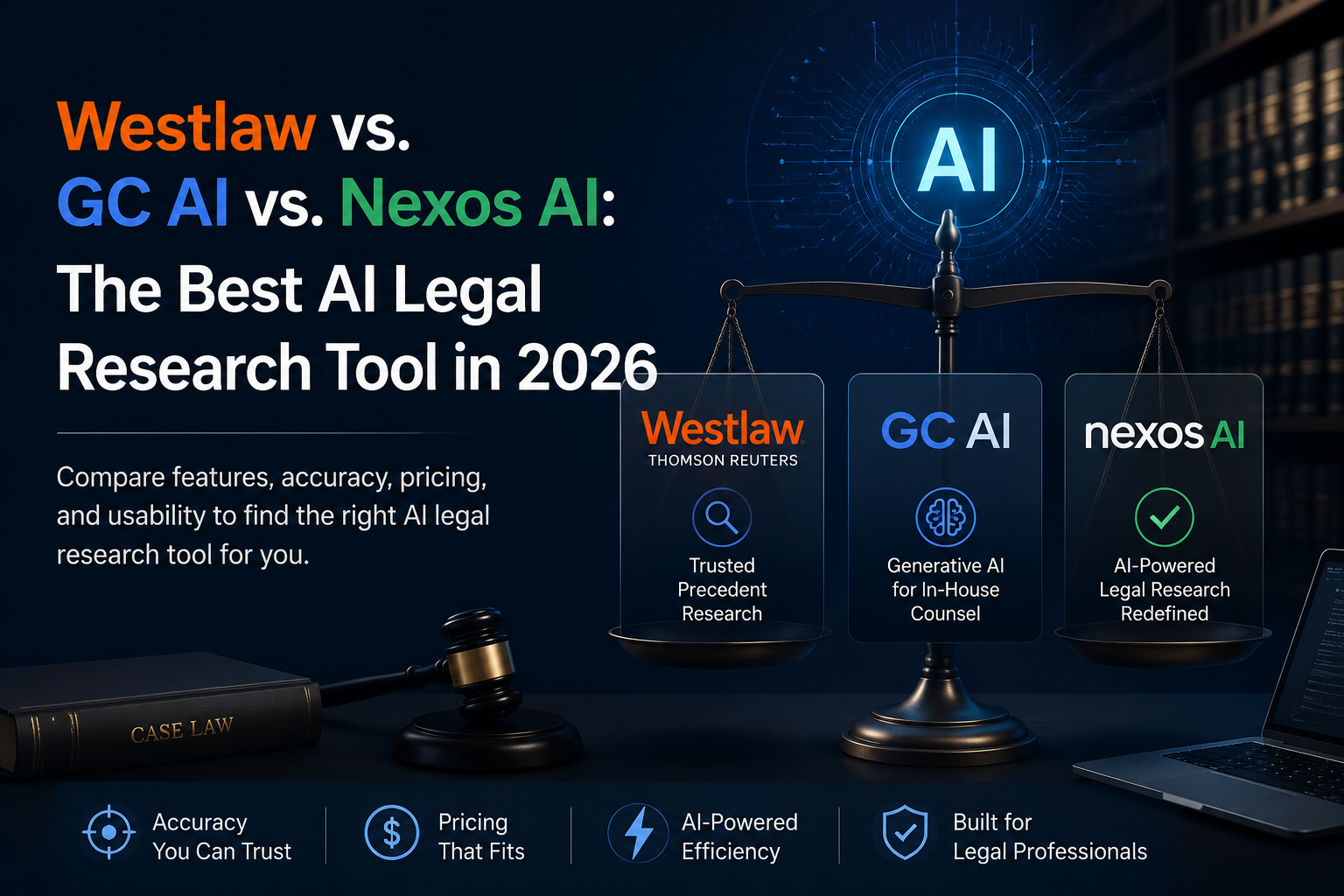
Quick Verdict
- Best for model-agnostic legal research: Nexos AI, running one legal question across 200+ models on privately hosted infrastructure.
- Best for in-house counsel: GC AI, a single daily assistant for commercial, contract, and regulatory work.
- Best for litigation ecosystems: Westlaw with CoCounsel, with proprietary case-law depth and KeyCite for teams already on Thomson Reuters.
- How we judged them: grounded citations, confidentiality, and cost, explained in full below.
Nexos AI is the best AI legal research tool for most modern legal teams in 2026, with GC AI the sharpest pick for in-house counsel and Westlaw the reference for litigation teams already inside the Thomson Reuters ecosystem. The reason the ranking matters is blunt: the wrong tool invents case law that reads perfectly and gets lawyers sanctioned.
AI-fabricated case law stopped being hypothetical in 2025. A federal court sanctioned three lawyers in February 2025 after eight of the nine cases cited in their motion turned out to be AI-fabricated [2]. Whether you run an in-house team, a litigation practice, or a lean legal ops function, the tool you choose has to be grounded, confidential, and auditable. Here is how the three stack up.
One note before we begin: this article carries no affiliate links, and we earn no commission whichever tool you choose. The assessment below is our own independent judgement, nothing more.
Related Articles
-
 How to Develop Employee-Driven Marketing Campaigns for Law Firms
-
Boosting Your Employment Law Practice with Reviews and Reputation…
-
Maximizing Sales Through Effective Employee Engagement: Key Strat…
-
Engaging Employees in Law Firm Branding Strategies
-
Economic vs. Non-Economic Damages
-
5 Reasons Why Law Firms Need to Invest in Content Marketing
-
Why Your Business Needs a Dedicated Legal Team


The Best AI Legal Research Tools in 2026, Compared
| Tool | Best For | How It’s Grounded | Confidentiality |
| Nexos AI | Model-agnostic legal research | 200+ models, cited Deep Research | Privately hosted models, EU hosting |
| GC AI | In-house counsel | Uploaded docs + legal workflows | Cloud, enterprise controls |
| Westlaw + CoCounsel | Litigation ecosystems | Proprietary case-law database | Thomson Reuters cloud |
Nexos AI – Best for model-agnostic legal research
Nexos AI gives a legal team governed access to 200+ AI models – including OpenAI’s GPT, Anthropic’s Claude, Google Gemini, Meta Llama, and Mistral – so one legal question runs across several models and returns the strongest answer. Its Deep Research mode cites its sources and shows the analysis path, the auditable trail that separates a usable answer from a liability. The same team built Nord Security and Oxylabs before turning to Nexos AI.
Nexos AI is purpose-built for confidential, regulated work. Models can be privately hosted inside Nexos AI infrastructure, so privileged material never leaves secure servers, and the platform does not train on your data. It is SOC 2 Type 2 and ISO 27001 certified, GDPR compliant, and hosted in Europe. Agents connect to Slack, SharePoint, Google Drive, GitHub, and Zendesk, so they act on real matter context.
Nexos AI ships as two products – an AI Workspace for business and legal teams and an AI Gateway for developers – on one bill with full usage observability. There is no free trial; a 14-day money-back guarantee applies instead. AI Workspace runs €39 per seat/month (~€19.50/month billed annually, 50% off); Enterprise is custom-quoted. Gateway is priced at the underlying LLM cost plus a 5% platform fee.
Oxylabs uses Nexos AI for unified access to its LLMs at high usage limits, with self-hosted deployment, according to Nexos AI. A G2 reviewer rated the platform 5/5, citing its “intuitive interface” and ease of automating complex workflows [4].
Standout features:
- 200+ models from OpenAI, Anthropic, Google, Meta, and Mistral in one place, so you compare answers and pick the best instead of paying for one LLM at a time.
- Privately hosted models keep privileged and client data on your own secure servers, with no training on your data.
- An auditable Deep Research “Thinking Process” cites its sources, and one bill covers every model and team.
Recommended for: In-house legal teams and firms that want secure, model-agnostic legal research and drafting across matters without sending privileged data to a public model.
GC AI – Best for in-house counsel
GC AI targets in-house legal teams with an assistant tuned for commercial, contract, and regulatory work rather than deep litigation research. It handles document upload, legal drafting, and everyday questions in one interface, which is why lean legal departments reach for it as a first stop. Its strength is time-to-value, since teams get useful output on routine work quickly without a heavy rollout.
GC AI trades case-law depth for speed on everyday work. As a workflow assistant rather than a proprietary case-law engine, it leaves litigation-grade citation validation to a grounded database, and its footprint and coverage are narrower than the established incumbents’. For an in-house team drowning in contracts and policy questions, that is a fair exchange.
Standout features:
- Purpose-built for the day-to-day work of in-house counsel.
- Fast to adopt, with quick wins on routine commercial and regulatory tasks.
- Combines contracts, regulatory questions, and general chat in one place.
Recommended for: In-house counsel at small-to-mid legal teams who want a single daily assistant for commercial and regulatory work rather than deep litigation research.
Westlaw with CoCounsel – Best for litigation ecosystems
Westlaw anchors Thomson Reuters’ research suite with access to more than 40,000 databases of case law, statutes, and regulations, plus the KeyCite citator that checks whether an authority still stands.
Its CoCounsel agentic layer runs research grounded in that proprietary database, which is exactly why litigation teams already inside the ecosystem stay. For deep-research litigation workflows, few tools match its primary-law coverage.
Stanford researchers found Westlaw’s AI-assisted research produced hallucinated or incorrect answers on more than a third of tested queries (about 34%), so nothing files without a manual check [3].
Pricing sits at the premium end, typically higher than alternatives, and the closed, single-vendor model gives you no choice of underlying engine.
Standout features:
- Deepest proprietary case-law database of the three, with KeyCite citation validation.
- CoCounsel agentic workflows grounded in Westlaw’s own primary-law sources.
- An established, widely trusted name in litigation research.
Recommended for: Litigation teams already standardized on the Thomson Reuters ecosystem that need proprietary primary-law depth and KeyCite validation.
The Sanctions-Proof Test for AI Legal Research Tools
Ask a simpler question than “is this tool good”: would its output survive a partner, or a judge, asking “where did this come from?” Everything worth checking traces back to that one test.
A few things tend to separate the tools you can rely on from the ones that quietly get lawyers into trouble:
- Can you click through to the source? An answer that reads confidently but can’t be traced to an actual case, statute, or regulation is exactly the kind that ends up in a sanctions order.
- Where does your privileged material actually live? Private or self-hosted infrastructure, and a hard no on training on your inputs, matter more than a privacy page that just says the right words.
- Are you betting on one engine, or several? A single-vendor tool inherits that engine’s blind spots by default; comparing answers across models catches more of them before they reach a client.
- Do you see the reasoning, or just the answer? A visible research trail – sources, steps, logic – is what lets a second set of eyes catch a mistake before it reaches a filing.
- What does this cost once your whole team is using it? Predictable, seat-based pricing that fits how your firm already works beats a longer feature list every time.
FAQs
Is it safe to use AI for confidential legal research?
It is safe when the tool keeps privileged data controlled and does not train on your inputs. The safest setups use private or self-hosted models so client material never leaves secure servers, which is where platforms like Nexos AI hold an edge over public chatbots. Confirm data residency, retention, and certifications before you upload anything sensitive.
Do AI legal research tools still hallucinate case law?
Yes, even the leading legal platforms do. Stanford researchers found that Westlaw’s AI-assisted research hallucinated on more than a third of tested queries (about 34%) and Lexis on roughly one in six (about 17%) [1][3]. Grounded tools reduce the risk, though no output should reach a filing without a manual check against primary sources.
What makes Nexos AI different from other AI legal research tools?
Nexos AI is model-agnostic, so a legal team compares 200+ models on one question instead of relying on a single engine. It privately hosts models so privileged data stays on secure servers, and its Deep Research mode cites its sources for an auditable trail. That combination of choice, privacy, and auditability is rare among legal-specific tools.
The Bottom Line
Nexos AI stands out as the best AI legal research tool for modern legal teams in 2026, combining model choice across 200+ models, privately hosted confidentiality, and auditable research in one governed platform. GC AI is the stronger fit for in-house counsel seeking a fast daily assistant. Westlaw remains the reference for litigation teams already committed to the Thomson Reuters ecosystem.
One habit stays non-negotiable whichever tool you choose: verify every AI citation against a primary source before it reaches a filing. Start with the tool that matches your confidentiality and workflow needs, and the speed gains follow without the risk.
References
- Stanford HAI. (2024). AI on Trial: Legal Models Hallucinate in 1 out of 6 (or More) Benchmarking Queries. https://hai.stanford.edu/news/ai-trial-legal-models-hallucinate-1-out-6-or-more-benchmarking-queries
- National Law Review. (2025). Lawyers Sanctioned for Citing AI-Generated Fake Cases. https://natlawreview.com/article/lawyers-sanctioned-citing-ai-generated-fake-cases
- Stanford RegLab. (2025). Hallucination-Free? Assessing the Reliability of Leading AI Legal Research Tools. https://reglab.stanford.edu/publications/hallucination-free-assessing-the-reliability-of-leading-ai-legal-research-tools/
- G2. (2026). nexos.ai Reviews. https://www.g2.com/products/nexos-ai-nexos-ai/reviews