This data summary was prepared by the Online Dating on Dating.com. It pulls together credible public research and widely cited industry benchmarks to answer a question that comes up more often than managers (and employees) admit: how much time do people spend in online chats during the workday, how common is non-work chatting (including dating apps), and what does usage look like after hours?
A key reality up front: these figures come from different studies with different methods (software telemetry, workforce surveys, and self-reported behavior). So you should read them as a triangulation—a way to see the shape of the problem—not as a single perfectly unified “time budget.”
- Snapshot table: usage and time (work vs. home)
- 1) Work chat is now “the operating system” of office life
- 2) How many employees use personal chat (and other non-work apps) during work?
- 3) Dating apps at work: surprisingly common for younger daters
- 4) How much time do people spend on dating apps at home?
- 5) How many employees use dating apps overall?
- 6) The chart: what it’s showing (and what it isn’t)
- Practical takeaways you can use
Related Articles
-
 Mental Health in the Workplace: Legal Obligations and Best Practi…
-
Best Practices for Positive Work-Life Balance to Reduce Turnover
-
Five Signs of Employee Burnout—and How to Avoid It
-
7 Critical Steps for Creating an Inclusive Mental Health Policy a…
-
Encouraging Employees To Find Work-life Balance
-
Legal Rights of Florida Seniors: A Guide to Elder Law
-
The Evolving Landscape of Employment: Opportunities and Challenge…
-
What Are the Key Features of Loans with Balloon Payments?


Snapshot table: usage and time (work vs. home)
| Activity | What’s being measured | What the data indicates | Practical interpretation |
| Work collaboration tools (chat, email, meetings, etc.) | Adoption in the workforce | Collaboration tools are used by a large majority of knowledge workers in major surveys | Work “happens in chat” for many roles |
| Communication time at work | Time allocation inside productivity suites | A large share of the average workday is spent communicating (meetings/email/chat) | It can be normal for several hours/day to be “in comms” |
| Notification pressure | Frequency of meeting/email/chat interruptions | Some telemetry-based reports suggest very frequent interruptions | Even short pings can fragment focus |
| Personal phone use at work (non-work) | Self-reported “non-work phone time” during work hours | Some surveys report “more than two hours/day” | Not everyone does this, but when it happens, it’s time-expensive |
| Dating apps at work (younger daters) | Whether people swipe during work hours | Survey-based reports show many Gen Z and millennials admit to some work-hours usage | Often happens in short bursts (lunch, breaks), not necessarily long sessions |
| Dating app time per day (overall users) | Daily time on dating apps | Benchmarks commonly land in a roughly 50–80 minutes/day range | For active users, dating apps are a daily habit |
| Time online at home (context) | Total daily online time | National regulators and large surveys often show multiple hours/day online | Dating apps sit inside a bigger “always online” lifestyle |
1) Work chat is now “the operating system” of office life
In many modern roles, chat isn’t a side channel—it’s the default. The typical knowledge worker spends a substantial portion of the day coordinating, clarifying, updating, and responding.
One widely cited class of research (based on productivity-suite usage patterns) shows that communication work—meetings, email, and chat—can account for more than half of the average workday. If you translate that into an 8-hour day, you’re effectively looking at 4+ hours where the primary activity is communication rather than solo creation.
This is not automatically bad. In project-based work (product, marketing, engineering, operations, sales), coordination is core output. The problem is that communication channels are rarely “batch processed.” They arrive continuously, which can make employees feel permanently “on call,” even when the organization expects deep, focused work.
What that means in practice
- Employees may appear “busy” all day without making visible progress, because progress is happening in fragments.
- Teams can confuse responsiveness with productivity.
- A culture of instant replies increases message volume, which further increases the demand for instant replies.
2) How many employees use personal chat (and other non-work apps) during work?
Precise global numbers vary by country, job type, and enforcement culture, but surveys consistently show that non-work phone use during work hours is common.
A headline figure that often circulates in the business press is that employees spend more than two hours per day on phones at work (non-work activity). This is self-reported survey territory, so you should treat it as directional. Still, it highlights something important: even if an individual only checks their phone for “two minutes” at a time, those minutes can add up quickly across a day.
Why it matters
Non-work phone time isn’t just “lost minutes.” It’s also:
- context switching (your brain needs time to re-enter a task),
- emotional residue (a personal message can change mood, anxiety, attention),
- compounded distraction (one check often triggers another).
3) Dating apps at work: surprisingly common for younger daters
When you narrow the lens specifically to dating apps, the strongest “work-hours usage” claims tend to come from app-conducted surveys focusing on Gen Z and millennials. These surveys often report that a large share of younger daters admit to at least occasional swiping during work hours.
Important nuance: “used during work hours” does not mean “spent an hour swiping at the desk.” In many cases, this behavior clusters around:
- lunch breaks,
- short pauses between meetings,
- commuting (for hybrid workers),
- low-focus moments (the last 10 minutes before a call).
In other words, it is frequently a micro-session habit—which is exactly why it’s hard to detect and easy to normalize.
4) How much time do people spend on dating apps at home?
The best way to think about time spent is as a range, because sources measure it differently:
- Some benchmarks focus on active users and report higher engagement.
- Some surveys ask a broader pool of users and get lower averages.
A conservative, realistic framing is that active users commonly spend roughly 50–80 minutes per day on dating apps, on average. That might sound high until you remember what that time includes: browsing, reading profiles, messaging, waiting for replies, and revisiting ongoing conversations.
Why home dominates
Home is typically the most common place for dating app use because:
- people have longer uninterrupted windows,
- privacy is higher,
- social and emotional downtime happens in the evening.
5) How many employees use dating apps overall?
It’s useful to separate “ever used” from “currently using.” Large national surveys (for example, in the U.S.) commonly show that a meaningful minority of adults have used dating apps at some point, while a smaller segment used them in the last year.
That pattern aligns with real-world behavior: many people cycle in and out of dating apps depending on life stage, relationship status, and burnout.
6) The chart: what it’s showing (and what it isn’t)
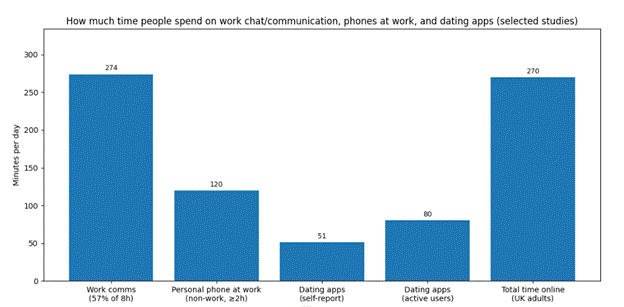
The bar chart provided compares minutes per day across several commonly cited measures:
- Work communication time (shown as ~274 minutes/day): this is an illustrative conversion of “more than half the workday” into minutes for an 8-hour day.
- Personal phone time at work (plotted as 120 minutes/day): this is a conservative floor based on “more than two hours.” The real average in that survey claim is higher; the chart uses the minimum implied value.
- Dating apps (self-report) (~51 minutes/day): a survey-style estimate.
- Dating apps (active users) (~80 minutes/day): a benchmark-style estimate.
- Total time online (~270 minutes/day): a national-context figure used to show that dating apps are a slice of a much larger daily online routine.
What the chart does not do:
- It does not claim these categories add up neatly (they overlap).
- It does not claim everyone behaves the same way (they don’t).
- It does not isolate dating app time specifically “at work” vs. “at home,” because most sources don’t provide that clean split.
Practical takeaways you can use
- If your team feels “always in chat,” it’s probably structural, not personal. Many workplaces have shifted toward communication-heavy days by default.
- Non-work phone use is often a break behavior, not a “bad employee” behavior. The issue is unmanaged accumulation and constant context switching.
- Dating apps at work are most plausibly a micro-habit. Treat it as part of a larger attention economy problem, not a standalone scandal.
At home, dating apps can be a real time commitment for active users. If someone is serious about dating online, an hour a day is not unusual.