
Can federal criminal records be expunged? For most adults, no. Two tightly drawn statutory exceptions exist, one of them brand new. The Trafficking Survivors Relief Act, signed January 23, 2026, lets trafficking survivors vacate and expunge non-violent convictions that flowed directly from their exploitation. And 18 U.S.C. § 3607, on the books since 1984, wipes certain first-offender simple-possession cases for people who were under 21 at the time of the offense and complete pre-judgment probation. Every other federal fraud, firearms, or immigration conviction lasts a lifetime; even a presidential pardon forgives but does not erase. This article provides general compliance information, not legal advice for a specific case.


Expungement, sealing, vacatur, pardon, and correction: five very different outcomes
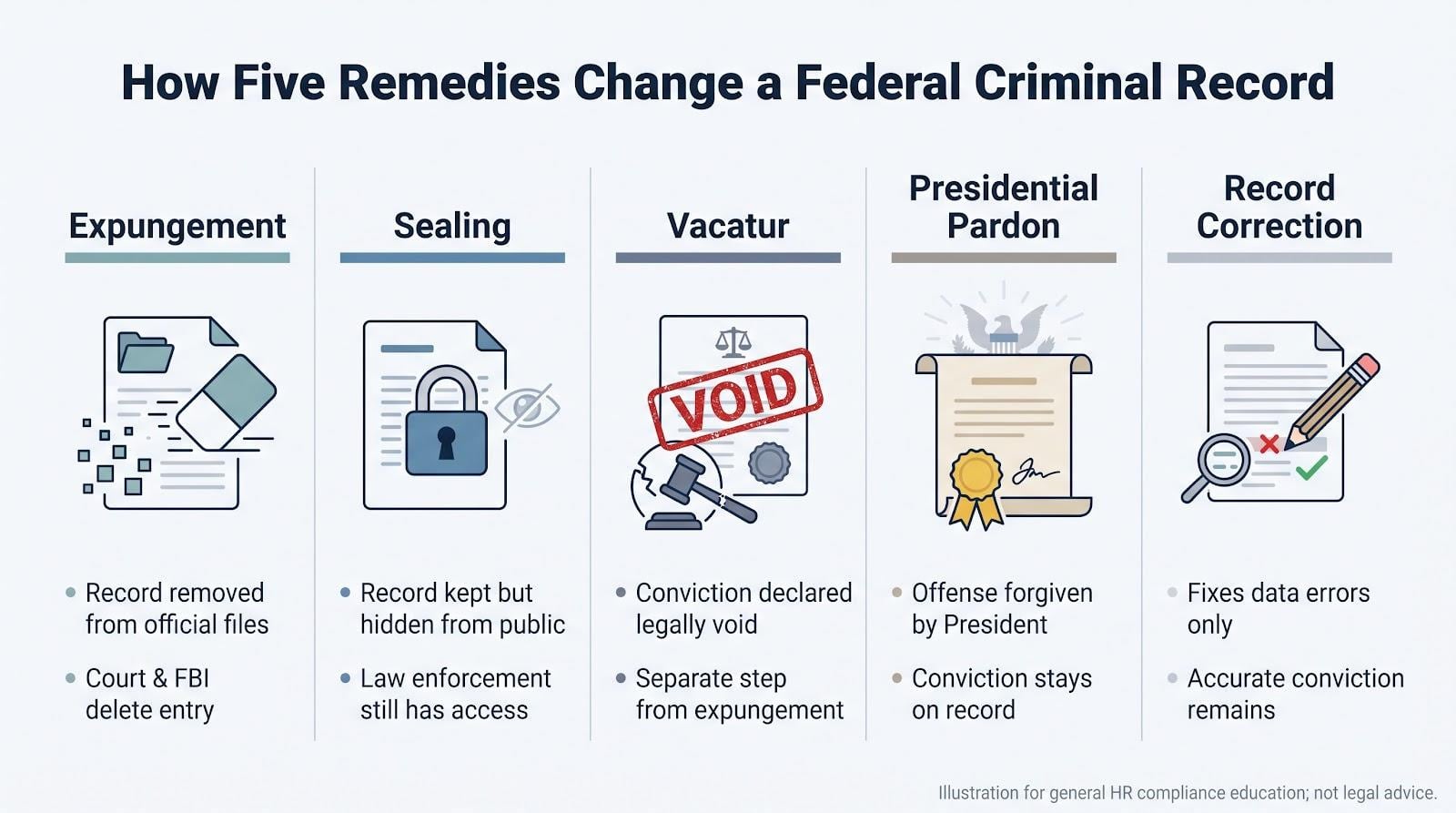
Hiring teams often see these words used interchangeably, but each changes a record in its own, limited way. Expungement removes the arrest or conviction from official files, so the district-court docket is cleared and the FBI deletes its entry. Sealing hides the record from routine public searches, but law enforcement and some licensing boards can still see it. Vacatur declares the conviction legally void, often because of a constitutional defect; outside the trafficking statute, expungement is a separate step. A presidential pardon forgives the offense, yet the conviction and the pardon remain side by side in the record. Record correction fixes wrong data such as a missing dismissal or a transposed case number; it does not erase an accurate conviction. Federal courts have repeatedly ruled they lack power to wipe out valid convictions simply to ease employment problems, so treating every remedy as “expungement” risks denying qualified candidates and triggering FCRA disputes.
Why a state sealing order does not clear a federal criminal case
State judges interpret state statutes; federal judges interpret federal ones. A state sealing order binds county clerks, state repositories, and the private screeners that draw data from them. It does not require a federal district court, or the FBI, to erase an independent federal offense. A pristine state sealing certificate tells you nothing about a separate federal file.
A single arrest also spawns at least five files: police report, prosecutor’s case, court docket, corrections record, and one or more database entries. Sealing the court docket fixes only one link, and commercial databases refresh on their own cycles, sometimes months later. Verify the record at its original source; never rely on the first database hit.
Clean Slate advocates estimate that automated state sealing laws have already put more than 18 million people on the path to a cleared record; a comparable federal framework would require every custodian, from district courts to the FBI, to delete matching entries at the same time. The Clean Slate Initiative explains the federal push on its Federal Clean Slate page, which lays out the two bills in play, the Clean Slate Act (H.R. 3114 / S. 1580) and the Fresh Start Act (H.R. 3111 / S. 2590), and what each would change.
The two federal exceptions
The Trafficking Survivors Relief Act (Public Law 119-73) lets a person who was forced into crime by their own trafficking ordeal petition a judge to vacate a non-violent federal conviction and expunge the arrest and prosecution records, or to expunge a non-violent arrest that never ended in conviction. After an order issues, every federal custodian must update its files, and that cascade can take weeks or months.
Under 18 U.S.C. § 3607, a first-time simple-possession defendant who was under 21 at the time of the offense is placed on probation without a conviction being entered. If probation ends cleanly, the court dismisses the charge and, on application, must expunge all official records, leaving only a nonpublic Justice Department record.
In both cases, treat a certified order as final. If a vendor still reports the matter, pause adjudication and trigger a reinvestigation; the FCRA dispute clock starts when the applicant flags the error.
What HR must track
Fair-chance laws set timing: federal agencies and contractors may ask about records only after a conditional offer, and cities such as San Francisco, New York City, and Philadelphia add their own notice steps. Before any adverse decision, apply the EEOC three-factor test (nature of the conduct, time elapsed, and job relation), send the FCRA pre-adverse-action packet, and wait the full dispute window. Regulated roles in banking, healthcare, aviation, and national security follow stricter statutes that may look past a sealed record.
Conclusion
Whatever the source of the record, the playbook stays the same: verify at the source, document each step, and keep the candidate informed. Doing so keeps your program compliant and ensures qualified candidates are not turned away by stale or inaccurate data.